Common Scoter
Melanitta nigra
The Common Scoter is a rare but regular winter visitor to Britain, typically seen in coastal areas, particularly in the north and west, from October to March. It can be spotted in large flocks on the sea, often at some distance from the shore.
Field Identification Guide
Use these features to identify Common Scoter in the field.
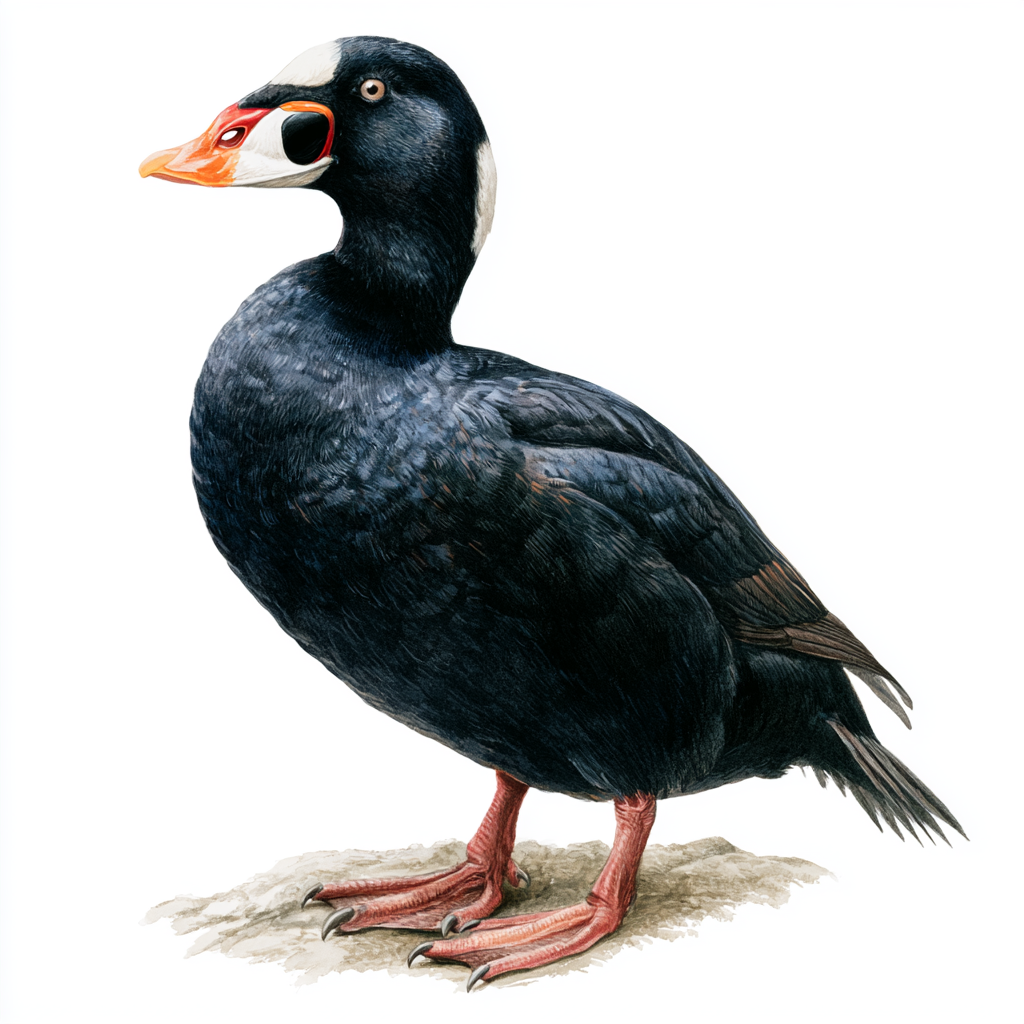
The Common Scoter can be identified by its black plumage, distinctive yellow knob at the base of the bill, and a rounded head shape. Its bill is also relatively large and heavy.
The Common Scoter is slightly larger than a Mallard, but smaller than a Goose, typically measuring between 43-54 cm in length.
The male Common Scoter has a glossy black plumage with a yellow knob at the base of the bill, which is more pronounced in breeding season.
The female Common Scoter is similar to the male but lacks the yellow knob at the base of the bill and has a duller, more brownish-black plumage.
The Common Scoter has a low, guttural call, often described as a soft "krek" or "krrak" sound.
Common Scoters are social birds that feed on the sea, diving for molluscs, crustaceans, and other marine animals, and can be seen flying in V-formation during migration.
The Common Scoter can be confused with other sea ducks, such as the Velvet Scoter and the Goldeneye, but can be distinguished by its black plumage, yellow bill knob, and larger size.
Quick Facts
Who's spotted this?
Loading...
Recent community sightings
Loading recent sightings...