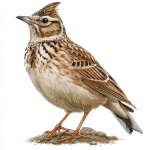
Crested Tit
Lophophanes cristatus
The Crested Tit is a notable species in Britain, primarily found in the ancient pinewoods of Inverness and Strathspey in Scotland, with rare sightings in England as a vagrant. It is a year-round resident, with most individuals remaining in their habitats throughout the year.
Field Identification Guide
Use these features to identify Crested Tit in the field.
The Crested Tit can be identified by its distinctive crest, white cheeks, and black stripe above its eye, which distinguish it from other tit species. Its grey-brown upperparts and white underparts also contribute to its unique appearance.
The Crested Tit is smaller than a Starling, roughly comparable in size to a Blue Tit or a Coal Tit.
The male Crested Tit has a grey-brown back, white underside, and a distinctive black and white striped head, with a prominent crest on top, which can be raised or lowered at will.
The female Crested Tit has similar plumage to the male, with no notable differences in colour or pattern.
The Crested Tit's call is a high-pitched, nasal "zee-zee-zee" or "tsee-tsee-tsee", often repeated in a series, while its song is a melodic, whistled phrase.
Crested Tits are acrobatic birds, often climbing up and down tree trunks in search of food, and flying in a rapid, darting motion between branches, with a notable habit of caching seeds for later use.
The Crested Tit can be confused with the Marsh Tit or the Coal Tit, but can be distinguished by its distinctive crest and white cheek patches, which are lacking in the other two species.
Quick Facts
Who's spotted this?
Loading...
Recent community sightings
Loading recent sightings...