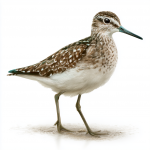
Yellow Wagtail
Motacilla flava
The Yellow Wagtail is a rare but annual migrant to Britain, typically seen during the spring and autumn months, with a few pairs breeding in the country, particularly in wetland areas. It is most often spotted in eastern and southern England, where its bright yellow plumage stands out against the landscape.
Field Identification Guide
Use these features to identify Yellow Wagtail in the field.
The Yellow Wagtail can be identified by its bright yellow head and underparts, long tail, and distinctive black stripe above its eye, with a grey or greenish-grey back and wings. Its yellow throat and breast, and black or dark brown legs, also help distinguish it from other wagtail species.
The Yellow Wagtail is slightly smaller than a Starling, measuring around 16-19 cm in length, and larger than a Blue Tit.
The male Yellow Wagtail has a bright yellow head, neck, and underparts, with a grey or greenish-grey back and wings, and a black stripe above its eye, with some variation in colour intensity and pattern depending on the subspecies.
The female Yellow Wagtail is similar to the male but often has a more subdued yellow colouration, with a paler yellow head and underparts, and a browner back and wings.
The Yellow Wagtail's call is a sharp, high-pitched "tswee" or "zee", often repeated in a series, while its song is a melodic, whistling phrase, typically heard during the breeding season.
The Yellow Wagtail is a ground-foraging bird, often walking or running in search of insects and other small invertebrates, and can be seen flying low over wetlands or fields, with a distinctive, bobbing flight style.
The Yellow Wagtail can be confused with other wagtail species, such as the Grey Wagtail or the Pied Wagtail, but can be distinguished by its bright yellow head and underparts, and its distinctive black stripe above its eye, as well as its more subdued grey or greenish-grey back and wings.
Quick Facts
Who's spotted this?
Loading...
Recent community sightings
Loading recent sightings...