Pallas’s Sandgrouse
Syrrhaptes paradoxus
Pallas's Sandgrouse is a rare and occasional visitor to Britain, typically seen in the eastern and southern regions during the spring and autumn migrations. It is a medium to large bird that can be spotted in open, dry areas with low vegetation.
Field Identification Guide
Use these features to identify Pallas’s Sandgrouse in the field.
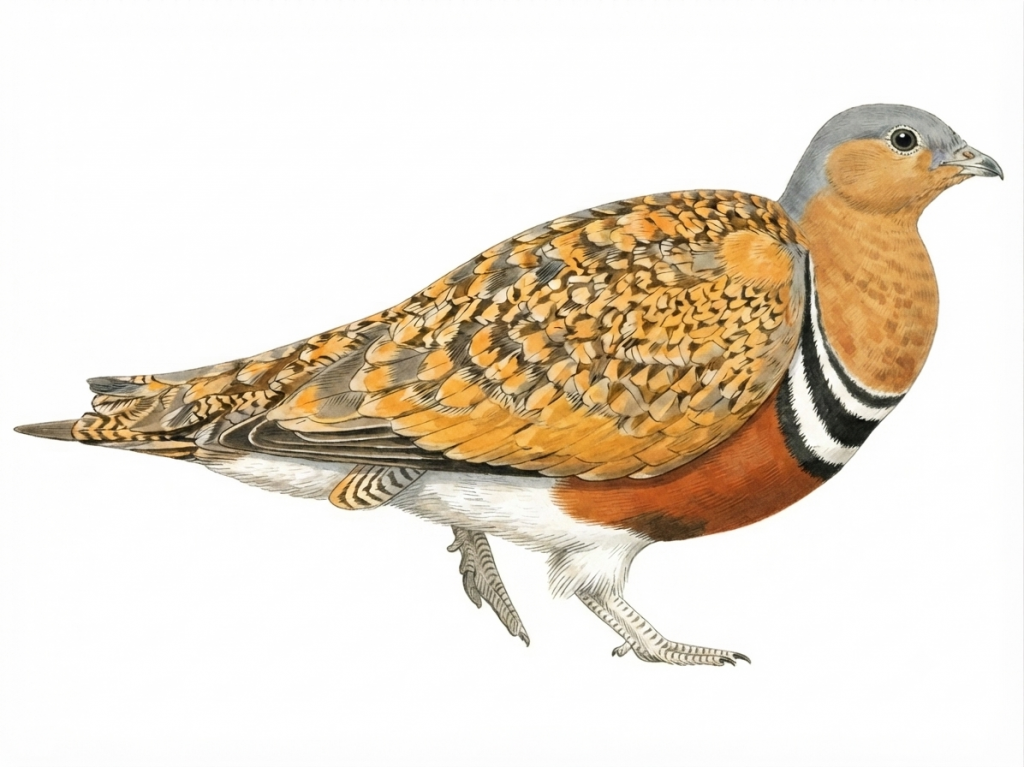
At a glance, Pallas's Sandgrouse can be identified by its stout body, long wings, and distinctive black belly patches, as well as its grey-brown back with black stripes.
The Pallas's Sandgrouse is larger than a Blue Tit, but smaller than a Woodpigeon.
The male Pallas's Sandgrouse has a grey-brown back with black stripes, a black belly, and a white forehead and throat patch, with some seasonal variation in the intensity of the colours.
The female Pallas's Sandgrouse is similar to the male, but with a more subdued colour pattern and less pronounced black belly patches.
The call of the Pallas's Sandgrouse is a series of chirping or chattering sounds, often described as a loud, sharp "chip-chip-chip" or "krit-krit-krit".
Pallas's Sandgrouse are ground-dwelling birds that feed on seeds, grains, and insects, often running or walking to cover large distances in search of food and water, and taking to the air with a swift, direct flight when disturbed.
Pallas's Sandgrouse can be confused with other sandgrouse species, such as the Black-bellied Sandgrouse, but can be distinguished by its grey-brown back with black stripes and distinctive black belly patches.
Quick Facts
Who's spotted this?
Loading...
Recent community sightings
Loading recent sightings...