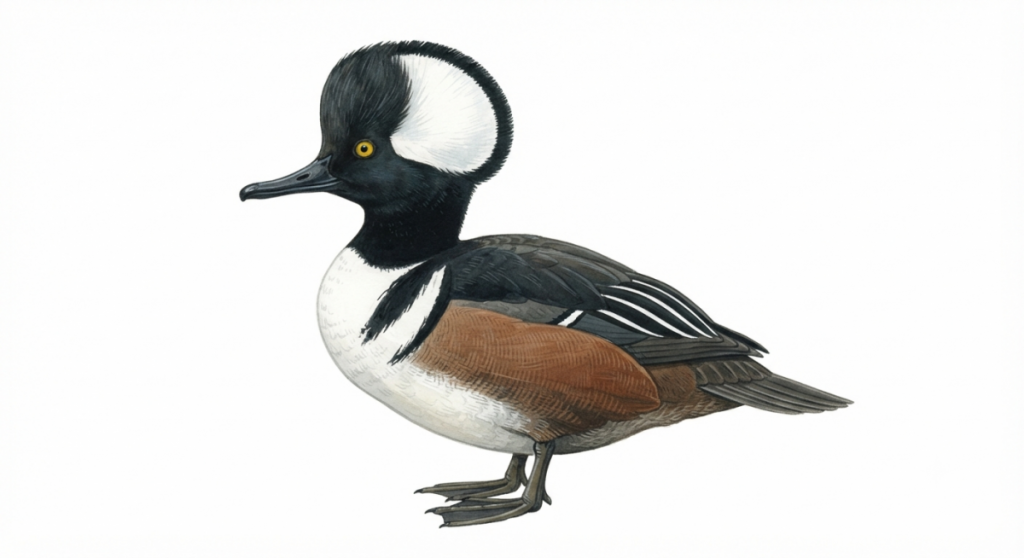
Hooded Merganser
Lophodytes cucullatus
The Hooded Merganser is a rare and occasional visitor to Britain, typically seen on freshwater wetlands and estuaries during the winter months, with sightings often associated with wildfowl collections or escapes. It is a striking and distinctive species, with its unique crest and plumage making it a sought-after sighting for British birdwatchers.
Field Identification Guide
Use these features to identify Hooded Merganser in the field.
The Hooded Merganser can be identified by its distinctive black and yellow crest, which can be raised or lowered, as well as its sawbill and handsome black and white breeding plumage, with the male's white patch on the side of its head being a key distinguishing feature.
The Hooded Merganser is slightly larger than a Goldeneye, with a similar size and build to other medium-sized ducks.
The male Hooded Merganser has a black head with a white patch on the side, a black back, and white flanks, with a black and white striped breast and belly, and its crest is black with a yellow border, with the breeding plumage being the most striking and colourful.
The female Hooded Merganser has a greyish-brown head and body, with a greyish-black crest and a less striking overall appearance than the male, although she still retains the distinctive sawbill and crest.
The Hooded Merganser's call is a high-pitched, squeaky whistle, often transcribed as a sharp "kek" or "tik" sound, and is typically heard from males during the breeding season.
The Hooded Merganser is a fish-eating duck that dives to feed on aquatic prey, with a fast and agile flight style, and is often seen swimming and diving in small groups or pairs, with a tendency to be secretive and elusive.
The Hooded Merganser can be confused with other sawbills, such as the Goosander or Red-breasted Merganser, but can be distinguished by its distinctive crest and black and white breeding plumage, as well as its smaller size and more compact build.
Quick Facts
Who's spotted this?
Loading...
Recent community sightings
Loading recent sightings...


