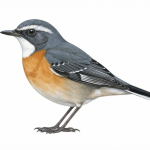
Red-headed Bunting
Emberiza bruniceps
The Red-headed Bunting is a rare and occasional vagrant to Britain, with most sightings occurring during migration periods, and can be spotted in a variety of habitats, including grasslands and wetlands. In Britain, it is most likely to be seen in the late spring or early autumn, although reports have declined significantly in recent years.
Field Identification Guide
Use these features to identify Red-headed Bunting in the field.
The Red-headed Bunting can be identified by its distinctive red head, white moustachial stripe, and brown back, with a stout bill and a distinctive white wing bar. Its red head and white stripe are key distinguishing features, setting it apart from other similar species.
The Red-headed Bunting is slightly smaller than a Starling, with a more compact and stocky build, making it a medium-sized passerine bird.
The male Red-headed Bunting has a bright red head, a white moustachial stripe, and a brown back, with a distinctive white wing bar and a pale underside, with a seasonal variation in brightness and intensity of the red head colour.
The female Red-headed Bunting is similar to the male, but with a more subdued and streaked brown head and back, lacking the bright red colouration of the male, although some females may retain a hint of red on the crown.
The Red-headed Bunting has a distinctive and melodic song, often described as a series of whistled phrases, and a sharp, metallic call, used for contact and alarm.
The Red-headed Bunting is a ground-foraging bird, feeding on seeds, grains, and insects, and can be seen walking or running on the ground, with a distinctive flight style, characterized by a series of rapid wingbeats and a short glide.
The Red-headed Bunting can be confused with the Black-headed Bunting, but can be distinguished by its brighter red head colour, white moustachial stripe, and brown back, whereas the Black-headed Bunting has a darker, more sooty head and a greyer back.
Quick Facts
Who's spotted this?
Loading...
Recent community sightings
Loading recent sightings...