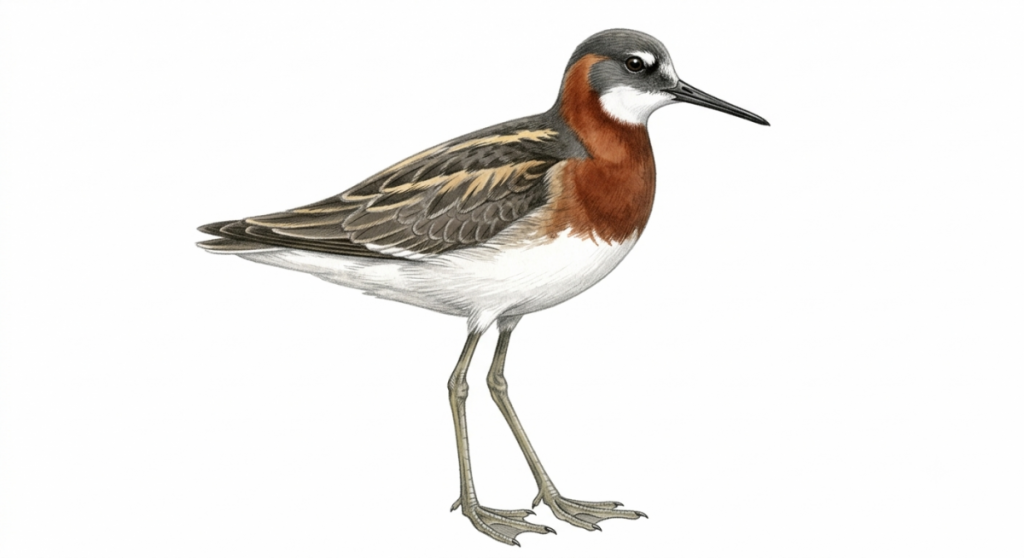
Red-necked Phalarope
Phalaropus lobatus
The Red-necked Phalarope is a rare but intriguing visitor to Britain, typically seen during its migration periods, particularly in the autumn, when it can be spotted in coastal areas and wetlands. It is most often encountered in the northern and western parts of the country.
Field Identification Guide
Use these features to identify Red-necked Phalarope in the field.
At a glance, the Red-necked Phalarope can be identified by its distinctive grey and white plumage, long, fine bill, and rapid, whirring wingbeats. Its black neck patch, which gives the species its name, is also a key identification feature.
The Red-necked Phalarope is smaller than a Starling, measuring approximately 18-20 cm in length.
The male Red-necked Phalarope has a grey back, white belly, and a distinctive black neck patch, with a reddish-brown tinge to the neck in breeding plumage, which is typically seen in the summer months.
The female Red-necked Phalarope has more vibrant plumage than the male, with a brighter reddish-brown neck patch and more pronounced colouration, making her more conspicuous during the breeding season.
The Red-necked Phalarope's call is a sharp, high-pitched "tit" or "chip" sound, often repeated in a rapid sequence.
Red-necked Phalaropes are known for their unique feeding behaviour, where they swim in tight circles, creating a whirlpool that brings small crustaceans and insects to the surface, which they then pick off with their fine bills. They are also agile fliers, with rapid, whirring wingbeats.
The Red-necked Phalarope can be confused with the Grey Phalarope, but can be distinguished by its smaller size, finer bill, and more distinctive black neck patch, as well as its more rapid wingbeats and unique feeding behaviour.
Quick Facts
Who's spotted this?
Loading...
Recent community sightings
Loading recent sightings...


