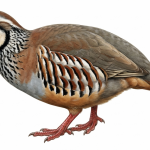
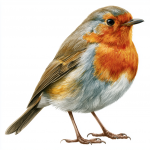
Sanderling
Calidris alba
The Sanderling is a small wading bird that can be seen in Britain during its migration and winter months, typically on coastal mudflats and sandy beaches, particularly in the southwest and western coasts. It is a rare breeder in Britain, with only a few pairs nesting in the northernmost parts of Scotland.
Field Identification Guide
Use these features to identify Sanderling in the field.
The Sanderling can be identified by its pale plumage, black legs, and distinctive feeding behaviour, where it runs back and forth on the beach, chasing waves to catch small invertebrates. Its brownish-grey back and white underside also help to distinguish it from other similar species.
The Sanderling is smaller than a Starling, measuring around 18-20 cm in length, making it a relatively small wader.
The male Sanderling has a brownish-grey back and white underside, with a black patch on its forehead and a distinctive black stripe running through its eye, with some variation in plumage depending on the season.
The female Sanderling is similar to the male, with slight variations in the intensity of the plumage colours, but overall, the sexes are not easily distinguishable by plumage alone.
The Sanderling's call is a sharp, high-pitched "weet" or "wit" sound, often repeated in a series of three or four notes.
Sanderlings are highly gregarious in winter, often forming large flocks on coastal mudflats and sandy beaches, where they feed on small invertebrates, such as crustaceans and molluscs, by running back and forth with the waves.
The Sanderling can be confused with the Dunlin, but can be distinguished by its pale plumage, black legs, and distinctive feeding behaviour, as well as its lack of a long, curved bill, which is characteristic of the Dunlin.
Quick Facts
Who's spotted this?
Loading...
Recent community sightings
Loading recent sightings...