Song Sparrow
Melospiza melodia
The Song Sparrow is a rare visitor to Britain, typically seen during migration periods or as a vagrant, often in coastal areas or near wetlands. It is most likely to be spotted in the UK during the autumn or winter months, although sightings are extremely uncommon.
Field Identification Guide
Use these features to identify Song Sparrow in the field.
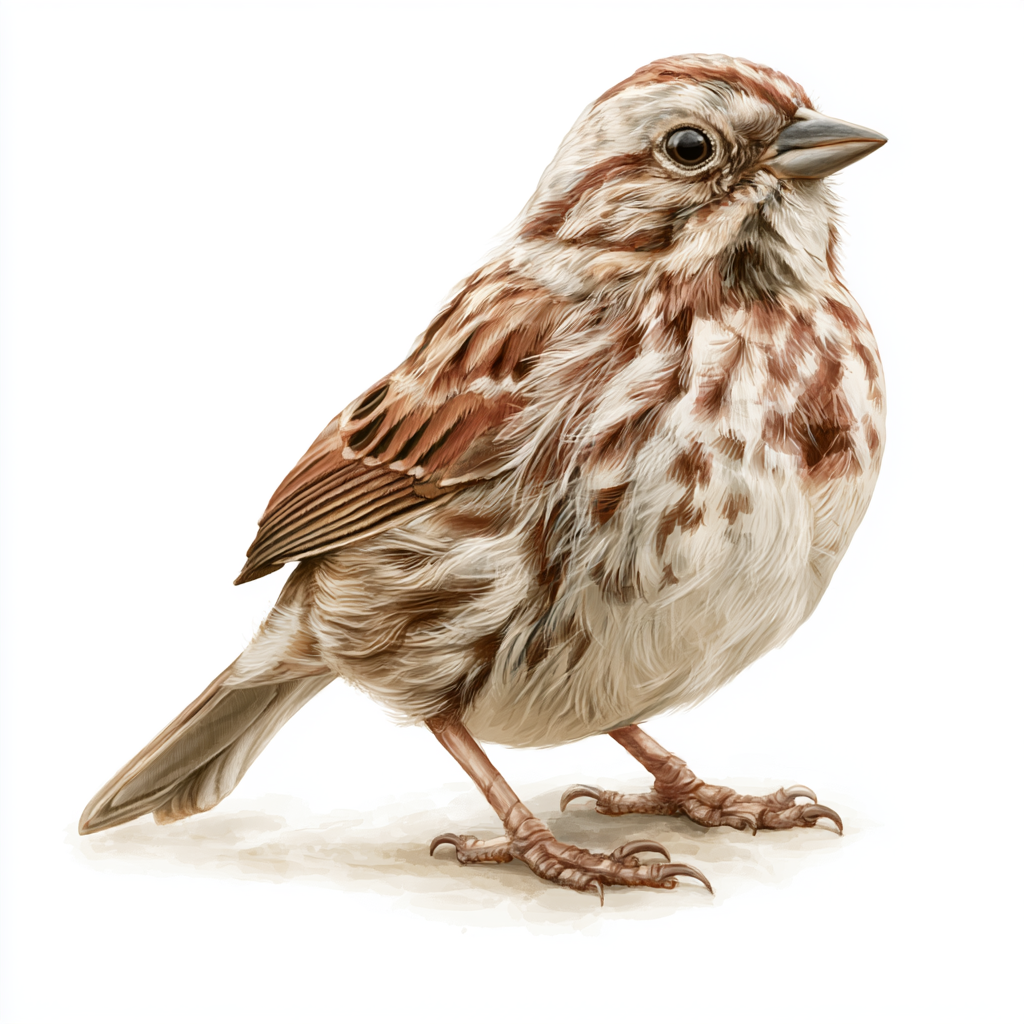
The Song Sparrow can be identified by its streaked breast, greyish-brown back, and distinctive black spot on its chest, as well as its rounded tail and short, conical bill. Its overall appearance is quite distinctive, with a mix of brown, grey, and black plumage.
The Song Sparrow is slightly smaller than a Starling, measuring around 12-14 cm in length, and is larger than a Blue Tit.
The male Song Sparrow has a brown back with black streaks, a greyish-brown chest with a black spot, and a white belly, with some variation in colouration depending on the subspecies and the time of year.
The female Song Sparrow is similar to the male, although her colours may be slightly duller and less intensely marked, making her slightly more difficult to distinguish.
The Song Sparrow's call is a series of sharp, musical notes, often described as a clear, whistled melody, while its song is a complex series of phrases and trills.
Song Sparrows are ground-foraging birds, feeding on seeds, insects, and other small invertebrates, and are often seen running or hopping along the ground in search of food, with a distinctive, bouncy flight style.
The Song Sparrow can be confused with other sparrow species, such as the Lincoln's Sparrow or the Swamp Sparrow, but can be distinguished by its distinctive black chest spot and streaked breast, as well as its overall size and shape.
Quick Facts
Who's spotted this?
Loading...
Recent community sightings
Loading recent sightings...