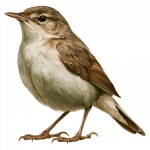
Thrush Nightingale
Luscinia luscinia
The Thrush Nightingale is a rare migrant in Britain, typically seen in the spring and autumn, and is most often encountered in dense undergrowth and woodland edges. It is more commonly found in northern Europe, but occasional sightings have been recorded in the UK, particularly in the eastern and southern regions.
Field Identification Guide
Use these features to identify Thrush Nightingale in the field.
The Thrush Nightingale can be identified by its reddish-brown tail, white belly, and distinctive white eye-ring, which distinguish it from other similar species. Its grey-brown back and wings also help to set it apart, with a subtle mottling effect that adds to its camouflage.
The Thrush Nightingale is slightly smaller than a Song Thrush, with a more compact build and a length of around 16-17 cm.
The male Thrush Nightingale has a grey-brown back and wings, with a reddish-brown tail and a white belly, and its plumage remains relatively consistent throughout the year, with no significant seasonal variation.
The female Thrush Nightingale is similar to the male, with the same grey-brown back and wings, reddish-brown tail, and white belly, making it difficult to distinguish between the sexes based on plumage alone.
The Thrush Nightingale's call is a sharp, metallic "tek" or "tchak" sound, often repeated in a series, while its song is a melodic, whistled phrase that is often described as more subdued than that of the Common Nightingale.
The Thrush Nightingale is an insectivorous species that forages for food on or near the ground, often in dense undergrowth, and its flight style is characterised by a rapid, darting motion, with a tendency to fly low to the ground.
The Thrush Nightingale can be confused with the Common Nightingale, but can be distinguished by its reddish-brown tail, white eye-ring, and more northerly distribution, as well as its more subdued song and sharper, more metallic call.
Quick Facts
Who's spotted this?
Loading...
Recent community sightings
Loading recent sightings...