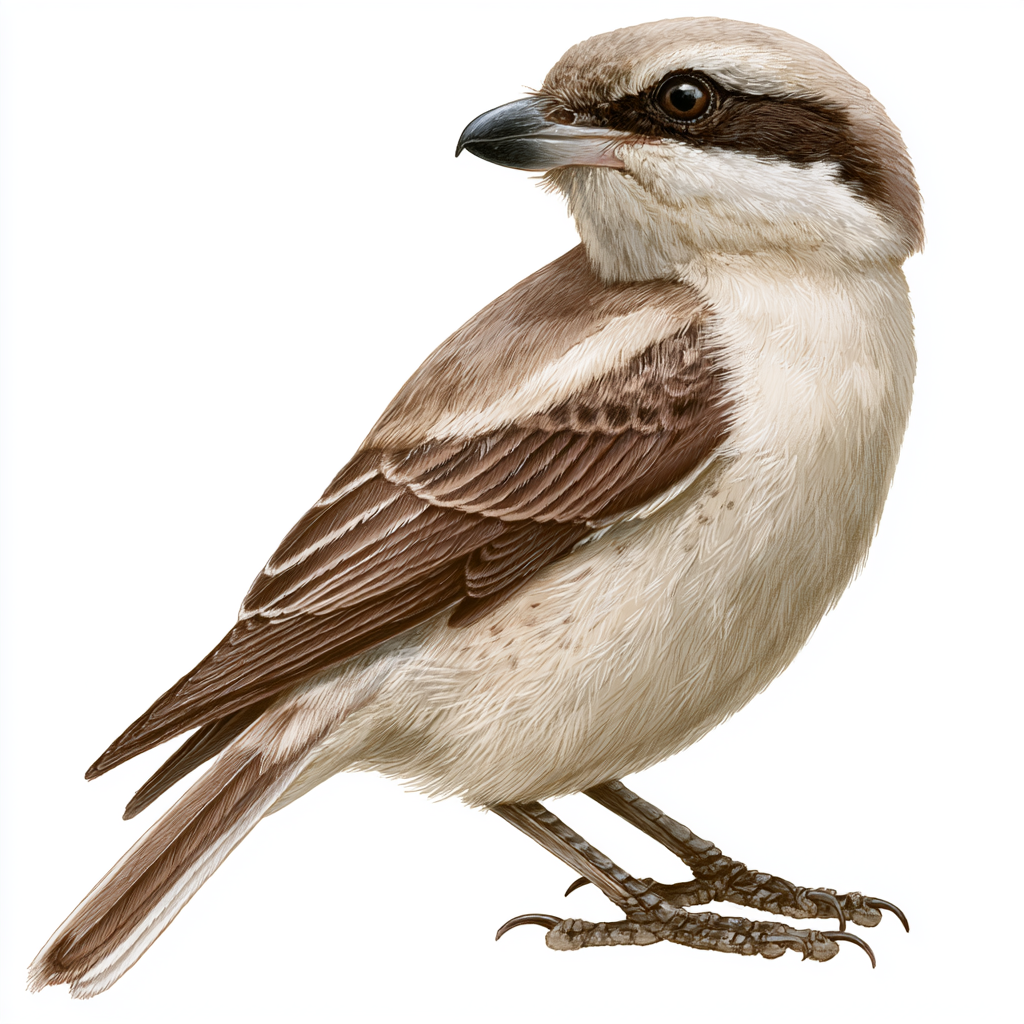
Turkestan Shrike
Lanius phoenicuroides
The Turkestan Shrike is a rare migrant to Britain, typically seen during the spring and autumn periods, and is most notable for its distinctive appearance and shrike-like behaviour. It is usually spotted in open countryside, often in areas with scattered trees and bushes.
Field Identification Guide
Use these features to identify Turkestan Shrike in the field.
The Turkestan Shrike can be identified by its reddish-brown tail, grey-brown back, and white underside, as well as its distinctive black mask and white throat patch. Its overall appearance is quite striking, with a sharp, hooked beak and a rounded wing shape.
The Turkestan Shrike is slightly smaller than a Starling, with a length of around 17-19 cm.
The male Turkestan Shrike has a grey-brown back, wings, and crown, with a reddish-brown tail and a white underside, and a distinctive black mask that extends from the beak to the back of the head.
The female Turkestan Shrike is similar to the male, but with a slightly more subdued colouration and a less pronounced black mask.
The Turkestan Shrike has a sharp, metallic call, often described as a loud, ringing "tink" or "tek" sound, which is frequently repeated.
The Turkestan Shrike is a predatory bird that feeds on insects, small vertebrates, and fruits, often perching on exposed branches or wires to scan for prey, and has a direct, swift flight style.
The Turkestan Shrike can be confused with the Red-backed Shrike or the Isabelline Shrike, but can be distinguished by its reddish-brown tail and grey-brown back, as well as its distinctive black mask and white throat patch.
Quick Facts
Who's spotted this?
Loading...
Recent community sightings
Loading recent sightings...