Turtle Dove
Streptopelia turtur
The Turtle Dove is a rare and elusive summer visitor to Britain, typically seen in the southern and eastern regions from May to September, with its numbers having declined significantly in recent years. It can be spotted in open woodland, farmland, and hedgerows, particularly in areas with abundant seed-bearing plants.
Field Identification Guide
Use these features to identify Turtle Dove in the field.
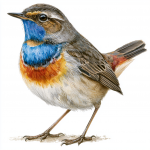
The Turtle Dove can be identified by its distinctive black neck patch, grey-brown upperparts, and scaly-looking breast feathers, as well as its slender tail and small size. Its overall appearance is also characterized by a subtle sheen to its feathers.
The Turtle Dove is smaller than a Woodpigeon, but larger than a Blackbird, making it a medium-sized bird that is easily overlooked.
The male Turtle Dove has a grey-brown back, wings, and tail, with a black neck patch and a pinkish-buff breast and belly, featuring a scaly pattern of black edges to its feathers.
The female Turtle Dove is similar to the male, but with a slightly duller and more subdued colouration, lacking the intense black neck patch and pinkish-buff tones.
The Turtle Dove's call is a low, mournful, and repetitive "tur-tur-tur" or "coo-coo-coo", often described as a gentle, soothing sound.
Turtle Doves are ground-foraging birds that feed on seeds, grains, and insects, often walking or running between patches of cover, and when alarmed, they take to the air with a swift, direct flight.
The Turtle Dove can be confused with the Collared Dove, but it is distinguished by its smaller size, more slender tail, and lack of a complete black collar around its neck, as well as its more subdued and scaly-looking plumage.
Quick Facts
Who's spotted this?
Loading...
Recent community sightings
Loading recent sightings...