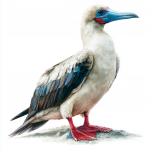
Two-barred Crossbill
Loxia leucoptera
The Two-barred Crossbill is a rare and irregular visitor to Britain, typically seen in coniferous woodlands during periods of irruption, often in response to food shortages in its native North American and Palearctic ranges. Sightings in Britain are usually sporadic and unpredictable, making it a highly sought-after species among twitchers.
Field Identification Guide
Use these features to identify Two-barred Crossbill in the field.
The Two-barred Crossbill can be identified by its distinctive crossed bill, white wing bars, and reddish-brown plumage, with the white wing bars being a key distinguishing feature from other crossbill species. Its head shape and bill structure are also notable, with a distinctive rounded head and a deeply crossed bill.
The Two-barred Crossbill is smaller than a Starling, measuring approximately 12-14 cm in length, and is larger than a Blue Tit, with a more compact and rounded body shape.
The male Two-barred Crossbill has a reddish-brown plumage with a greyish-brown crown and nape, and white wing bars, with the intensity of the red colouration varying depending on the subspecies and the individual bird.
The female Two-barred Crossbill has a similar plumage to the male, but with a more subdued colouration, often with a greenish-yellow tint to the brown plumage, and less intense red colouration.
The Two-barred Crossbill has a distinctive call, often described as a sharp, metallic "kip" or "tik" sound, and a song that consists of a series of descending whistled notes.
The Two-barred Crossbill is a specialist feeder on conifer seeds, using its unique crossed bill to extract seeds from conifer cones, and is often seen flying between trees in a swift, direct flight, with a distinctive wingbeat pattern.
The Two-barred Crossbill can be confused with the Common Crossbill, but can be distinguished by its white wing bars and more reddish-brown plumage, as well as its smaller size and more compact body shape.
Quick Facts
Who's spotted this?
Loading...
Recent community sightings
Loading recent sightings...