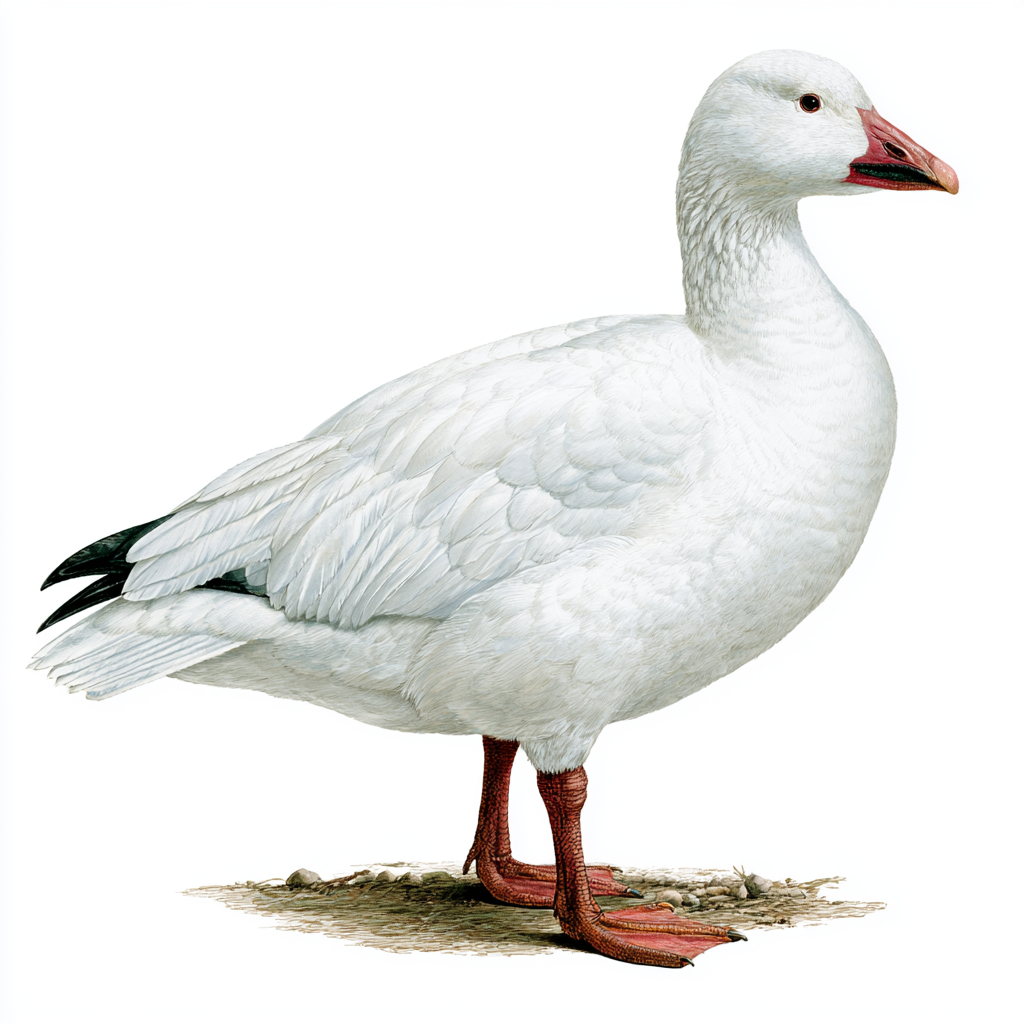
Snow Goose
Anser caerulescens
The Snow Goose is a rare but notable visitor to Britain, typically seen during migration periods or as a vagrant, often in coastal areas and wetlands. It can be spotted in the country from late winter to early spring, with occasional sightings throughout the year.
Field Identification Guide
Use these features to identify Snow Goose in the field.
The Snow Goose can be identified by its predominantly white plumage, black wing tips, and pinkish-red bill and legs, with the dark morph having a bluish-grey plumage. Its broad, rounded head and short neck are also distinctive features.
The Snow Goose is larger than a Greylag Goose, but smaller than a Swan, making it a medium to large-sized waterfowl.
The male Snow Goose has a white plumage with black wing tips, and a pinkish-red bill and legs, while the dark morph, also known as the Blue Goose, has a bluish-grey plumage.
The female Snow Goose is similar to the male, with the same white or bluish-grey plumage, although she may be slightly smaller and have a more subdued colouration.
The Snow Goose has a loud, high-pitched honking call, often described as a nasal "kank" or "hank" sound.
Snow Geese are social birds that often feed on grasses, leaves, and aquatic plants in large flocks, and are known for their V-formation flight pattern during migration.
The Snow Goose can be confused with the White-fronted Goose, but can be distinguished by its black wing tips and pinkish-red bill and legs, as well as its broader, more rounded head.
Quick Facts
Who's spotted this?
Loading...
Recent community sightings
Loading recent sightings...


