Barrow’s Goldeneye
Bucephala islandica
The Barrow's Goldeneye is a rare winter visitor to Britain, typically seen in coastal areas, particularly in the north and west, from October to April. It is most often spotted in small numbers, usually in association with other sea ducks, and its presence is always a notable event for British birdwatchers.
Field Identification Guide
Use these features to identify Barrow’s Goldeneye in the field.
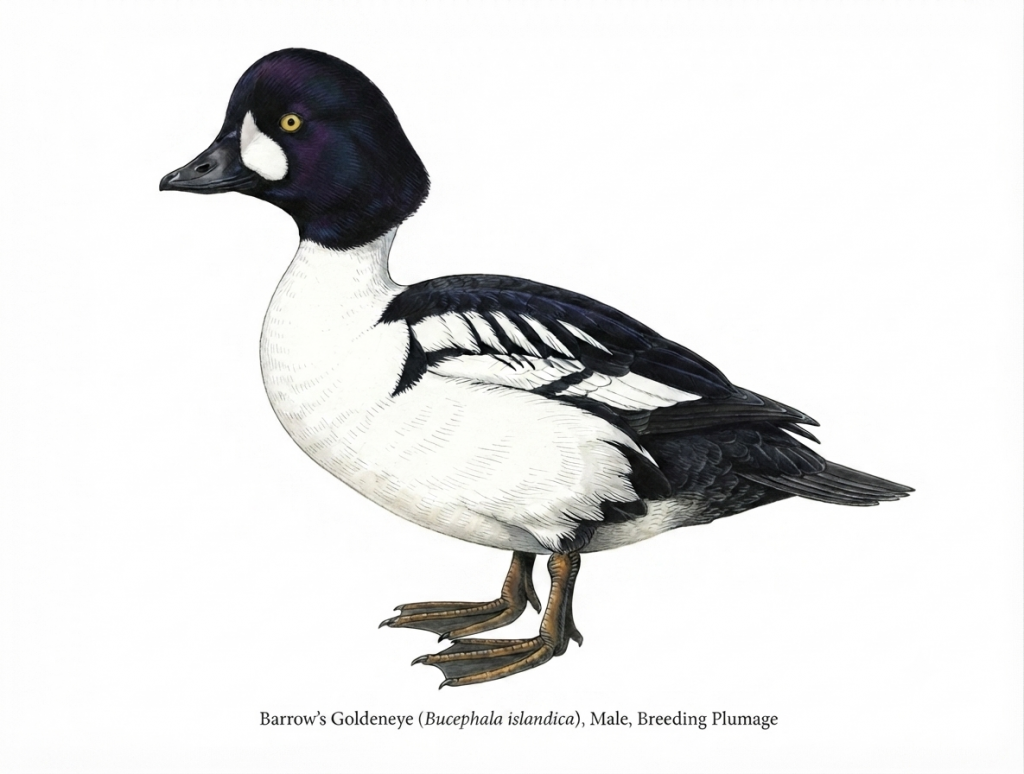
The Barrow's Goldeneye can be identified by its distinctive yellow eyes, black-and-white head pattern, and a yellow patch on the forehead, which distinguishes it from other goldeneye species. Its head shape and colouration are key features to look out for, along with its medium size and compact body.
The Barrow's Goldeneye is slightly larger than a Blue Tit, but smaller than a Mallard, making it a medium-sized sea duck that is easily overlooked in a crowded coastal scene.
The male Barrow's Goldeneye has a striking black-and-white head pattern, with a yellow patch on the forehead and yellow eyes, set against a black back and white belly, with a purple sheen to the head in certain lighting conditions.
The female Barrow's Goldeneye has a more subdued colouration, with a grey-brown head and body, and a yellow eye patch, but lacks the distinctive yellow forehead patch of the male, making it more challenging to identify.
The Barrow's Goldeneye has a distinctive, high-pitched call, often described as a sharp "pee-pee-pee" or "kreee-kreee-kreee", which is usually heard during courtship or when the birds are alarmed.
Barrow's Goldeneyes are diving ducks, feeding on aquatic invertebrates, such as crustaceans and molluscs, which they forage for in shallow coastal waters, often in association with other goldeneye species, and are known for their fast, direct flight style.
The Barrow's Goldeneye can be confused with the Common Goldeneye, but can be distinguished by its yellow eye patch, more rounded head shape, and lack of a white spot on the face, as well as its more subdued female plumage, which lacks the white forehead patch of the female Common Goldeneye.
Quick Facts
Who's spotted this?
Loading...
Recent community sightings
Loading recent sightings...