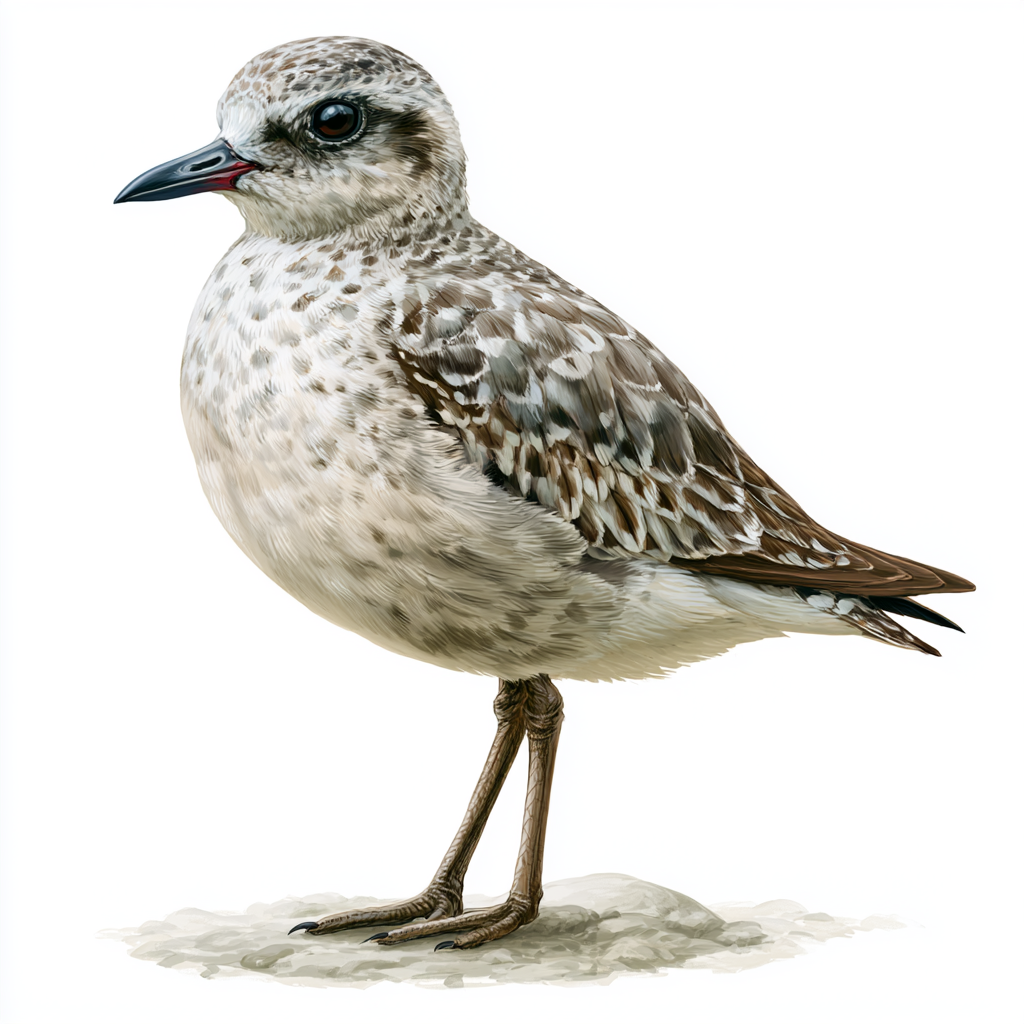
Grey Plover
Pluvialis squatarola
The Grey Plover is a rare but regular migrant to Britain, typically seen on coastal wetlands and estuaries during the spring and autumn, with some individuals wintering in the country. It is most often encountered in the UK from August to May, with the majority of sightings occurring in eastern and southern England.
Field Identification Guide
Use these features to identify Grey Plover in the field.
The Grey Plover can be identified by its grey-brown back, white belly, and distinctive black axillary feathers, as well as its long legs and straight, black bill. Its broad, rounded wings and white rump patch are also notable features.
The Grey Plover is larger than a Lapwing, but smaller than a Curlew, with a length of approximately 28-32 cm.
The male Grey Plover has a grey-brown back and wings, with a white belly and black axillary feathers, and develops a black belly patch during the breeding season, which is typically lost during the winter months.
Similar to the male, the female Grey Plover also has a grey-brown back and white belly, but may have a less pronounced or absent black belly patch during the breeding season.
The Grey Plover's call is a loud, whistled "pee-wee" or "chu-wee", often repeated in a series of three or four notes.
Grey Plovers are ground-foraging birds, using their long legs and straight bills to search for small invertebrates and crustaceans in mudflats and shallow water, and are often seen in flocks, particularly during migration and winter.
The Grey Plover can be confused with the Golden Plover, but can be distinguished by its larger size, greyer back, and black axillary feathers, as well as its more straightforward, whistled call.
Quick Facts
Who's spotted this?
Loading...
Recent community sightings
Loading recent sightings...


