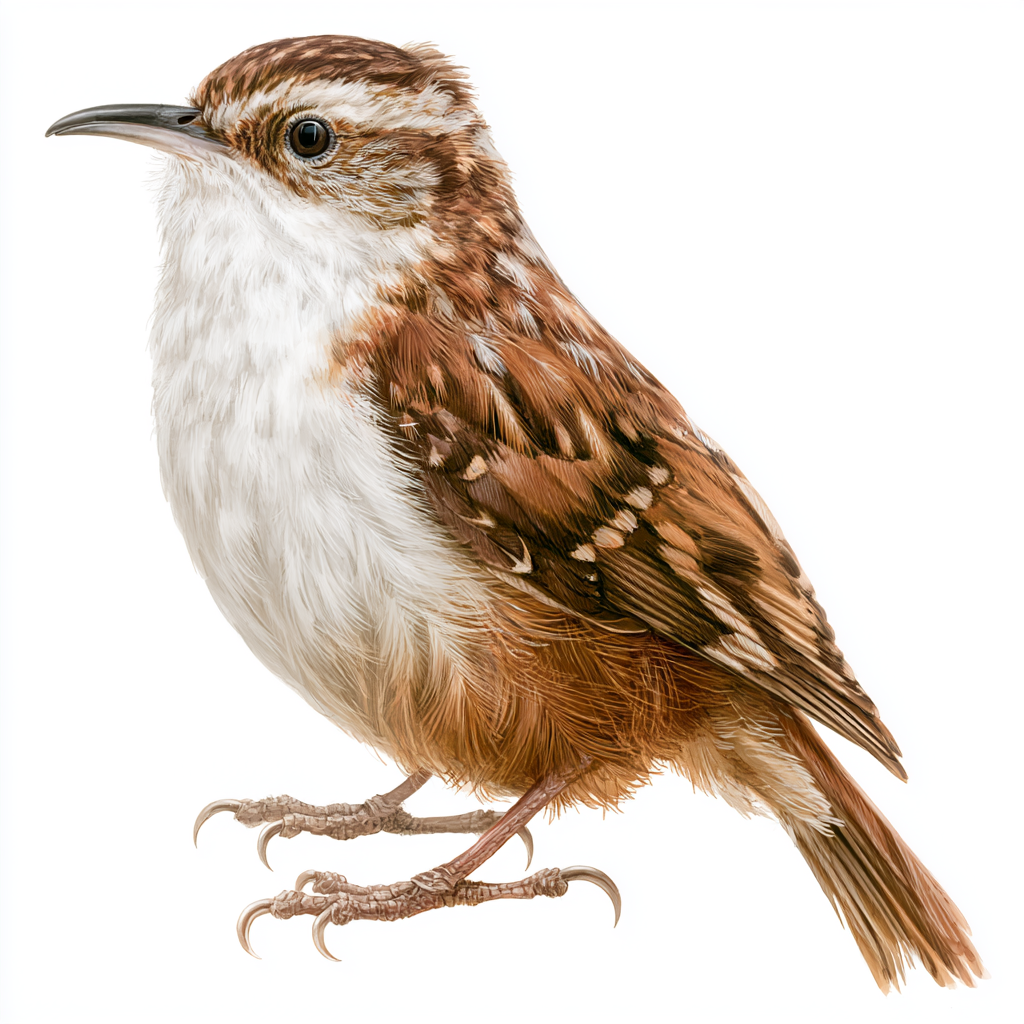
Treecreeper
Certhia familiaris
The Treecreeper is a common and widespread species in Britain, typically seen in woodlands, parks, and gardens with trees, particularly during the breeding season from March to July. It can be spotted climbing up tree trunks in search of food, often in areas with dense undergrowth and mature trees.
Field Identification Guide
Use these features to identify Treecreeper in the field.
The Treecreeper can be identified by its streaked brown back, white belly, and distinctive white eyebrow stripe, as well as its long, curved bill and stiff, pointed tail feathers. Its mottled brown plumage helps it blend in with tree bark, making it a challenge to spot.
The Treecreeper is smaller than a Starling, measuring around 12-13 cm in length, and is one of the smallest birds in British woodlands.
The male Treecreeper has a dull brown back with white streaks, a white belly, and a white eyebrow stripe above a dark eye stripe, with no significant seasonal variation in its plumage.
The female Treecreeper has similar plumage to the male, with no notable differences in colour or pattern.
The Treecreeper's call is a high-pitched, repetitive "tee-tee-tee" or "tsee-tsee-tsee", often heard during the breeding season, while its song is a series of short, musical phrases.
The Treecreeper is a solitary bird that climbs up tree trunks in search of insects, spiders, and other small invertebrates, using its long, curved bill to probe into crevices and its stiff tail feathers for support. It has a distinctive, wave-like flight pattern between trees.
The Treecreeper can be confused with the Short-toed Treecreeper, but the latter is rare in Britain and has a shorter toe and a more southerly distribution, as well as a less streaked back and a shorter bill.
Quick Facts
Who's spotted this?
Loading...
Recent community sightings
Loading recent sightings...


