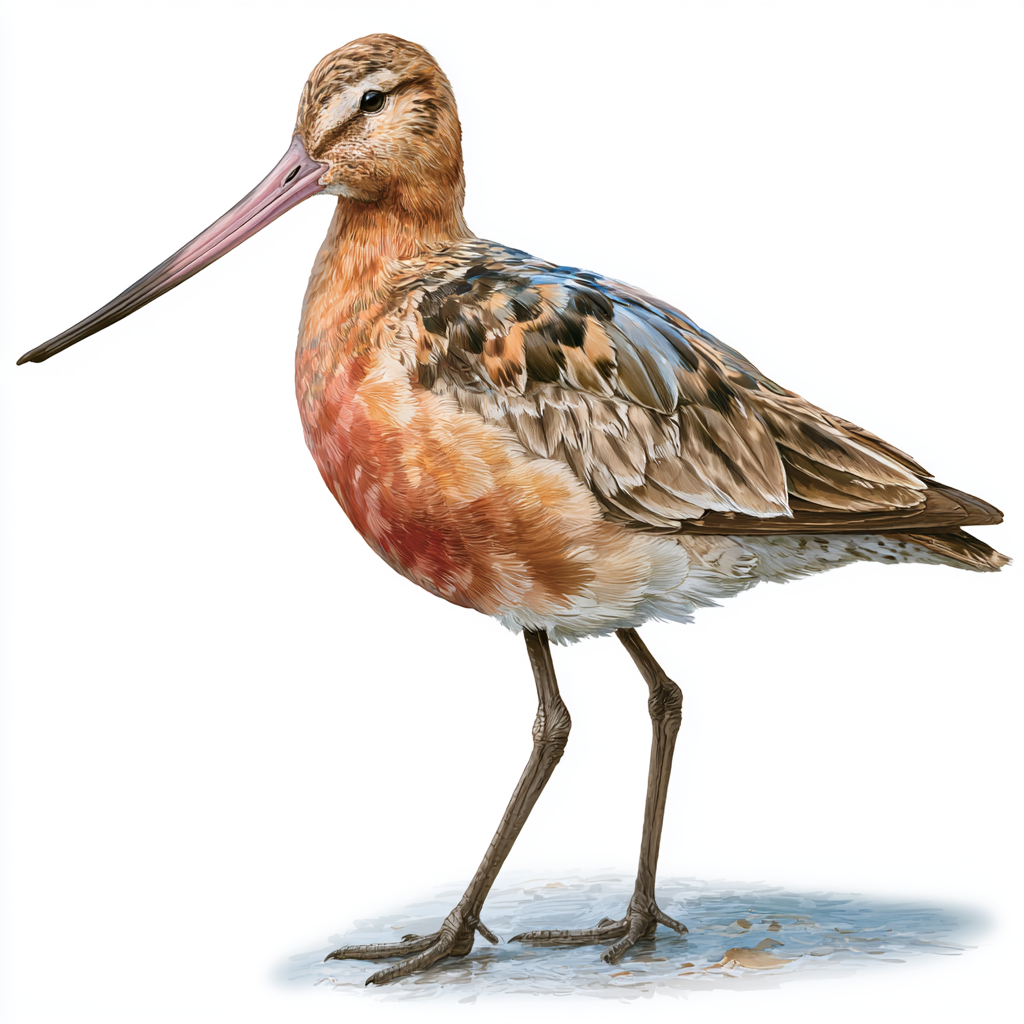
Hudsonian Godwit
Limosa haemastica
The Hudsonian Godwit is a rare migrant to Britain, typically seen during spring and autumn passage, often at coastal wetlands and estuaries. It is most likely to be spotted by keen birders at a few select locations, particularly in the northwest and northeast of the country.
Field Identification Guide
Use these features to identify Hudsonian Godwit in the field.
The Hudsonian Godwit can be identified by its long, straight bill, barred breast and belly, and distinctive white rump patch. Its upperparts are a mottled brown colour, helping it to blend in with its surroundings.
The Hudsonian Godwit is larger than a Redshank, but smaller than a Curlew, making it a medium to large-sized wader.
The male Hudsonian Godwit has a rich, reddish-brown breeding plumage, with a barred breast and belly, and a white belly patch, which is most pronounced during the breeding season.
The female Hudsonian Godwit is similar to the male, but with a slightly duller colouration, particularly in the breeding plumage, which can make it more challenging to distinguish between the sexes.
The Hudsonian Godwit's call is a loud, whistled "god-wit" or "wee-wit", often repeated in a series of two or three notes, which can be heard during migration and breeding.
The Hudsonian Godwit is a long-distance migrant, undertaking an annual journey from its breeding grounds in northern Canada to its wintering grounds in southern South America, and can be seen feeding on small invertebrates and molluscs in coastal wetlands and mudflats.
The Hudsonian Godwit can be confused with the Black-tailed Godwit, but can be distinguished by its straighter bill, more barred breast and belly, and a white rump patch, as well as its more reddish-brown breeding plumage.
Quick Facts
Who's spotted this?
Loading...
Recent community sightings
Loading recent sightings...


