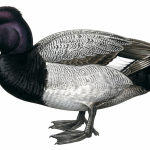
Spotted Sandpiper
Actitis macularius
The Spotted Sandpiper is a rare migrant to Britain, typically seen during the summer months, particularly in the southern and western regions, often near freshwater habitats. It is a small shorebird that can be spotted on mudflats, riverbanks, and lake shores, although sightings are infrequent and usually involve individual birds.
Field Identification Guide
Use these features to identify Spotted Sandpiper in the field.
The Spotted Sandpiper can be identified by its brown back with dark spots, white belly, and distinctive yellowish-orange legs, as well as its teardrop-shaped spots on its breast and belly. Its overall appearance is also characterized by a long, straight black bill and a rounded breast.
The Spotted Sandpiper is smaller than a Starling, measuring approximately 18-20 cm in length, making it a relatively small wader.
The male Spotted Sandpiper has a brown back with dark spots, a white belly, and a breast with teardrop-shaped spots, which are more pronounced during the breeding season, with the spots becoming less distinct in winter.
Similar to the male, the female Spotted Sandpiper also has a brown back with dark spots and a white belly, although the breast spots may be less intense, and the overall plumage can appear more subdued.
The Spotted Sandpiper's call is a high-pitched, whistled "weet-weet-weet" or "pee-pee-pee", often repeated in a series of three to five notes.
The Spotted Sandpiper is a solitary feeder, often walking or running along the water's edge in search of small invertebrates, and it has a distinctive habit of bobbing its rear end up and down as it forages, with a direct, swift flight when alarmed.
The Spotted Sandpiper can be confused with the Common Sandpiper, but it can be distinguished by its spotted breast and belly, yellowish-orange legs, and more rounded breast, as well as its smaller size and more subdued call.
Quick Facts
Who's spotted this?
Loading...
Recent community sightings
Loading recent sightings...