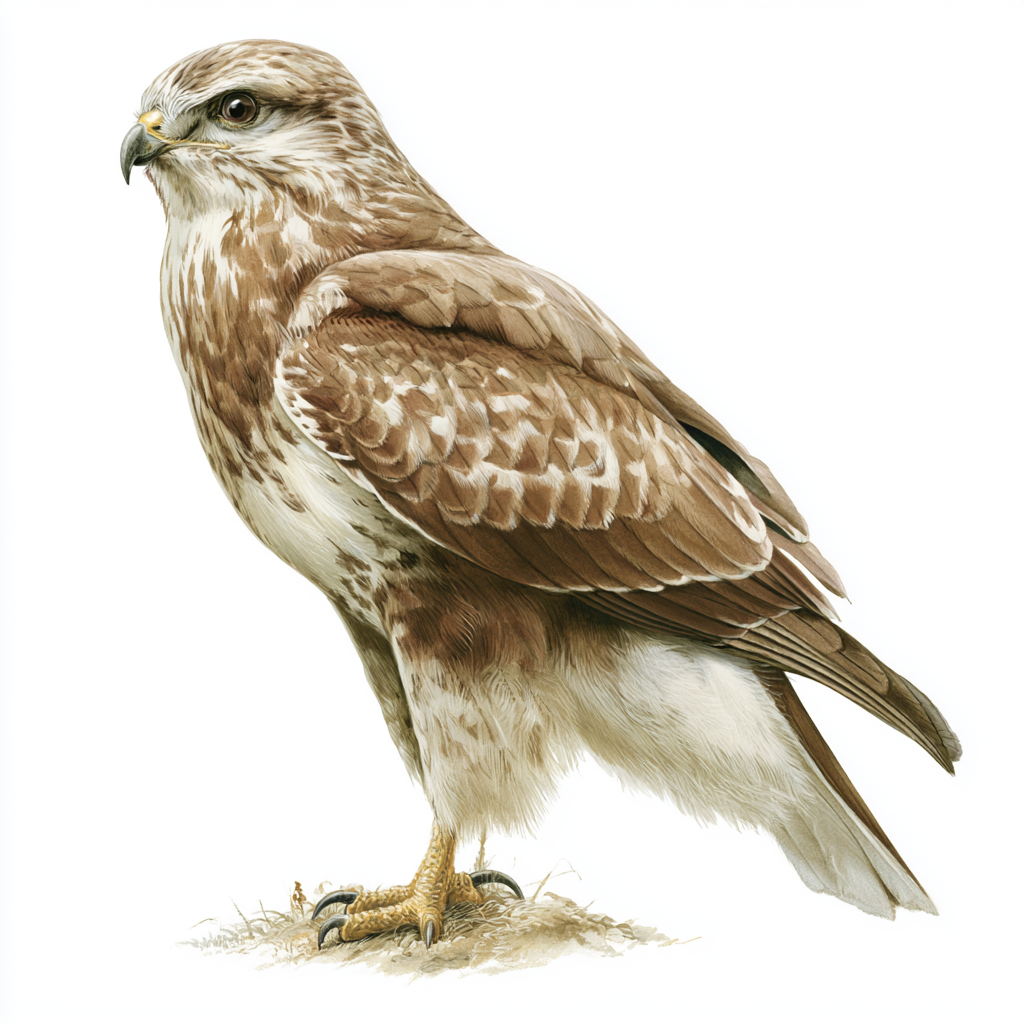
Long-legged Buzzard
Buteo rufinus
The Long-legged Buzzard is a rare visitor to Britain, typically seen in the southern regions during migration periods, although sightings are extremely uncommon. It is more commonly found in Southeastern Europe, East Africa, and the northern part of the Indian subcontinent.
Field Identification Guide
Use these features to identify Long-legged Buzzard in the field.
The Long-legged Buzzard can be identified by its broad wings, long tail, and distinctive leg feathers, as well as its pale underside with dark streaks and a pale orange-brown hue on its upperparts. Its wings and tail also exhibit a characteristic pale panel on the upperwing.
The Long-legged Buzzard is larger than a Common Buzzard, with a more sturdy build, making it a notable sight when seen in flight.
The male Long-legged Buzzard has a pale orange-brown back and wings, with a pale underside featuring dark streaks, and its leg feathers are long and densely feathered, giving it a distinctive appearance.
Similar to the male, the female Long-legged Buzzard has the same overall plumage pattern, with no significant differences in colouration or markings.
The Long-legged Buzzard's call is a loud, piercing "kee-kee-kee" or a sharp "kyek-kyek-kyek", often repeated in a series of short phrases.
The Long-legged Buzzard is a powerful and agile hunter, feeding on small mammals, reptiles, birds, and insects, and is known to be relatively sluggish in its flight, often soaring or perching for long periods.
The Long-legged Buzzard can be confused with the Common Buzzard, but can be distinguished by its longer legs, broader wings, and pale orange-brown upperparts, as well as its more sluggish flight style.
Quick Facts
Who's spotted this?
Loading...
Recent community sightings
Loading recent sightings...

