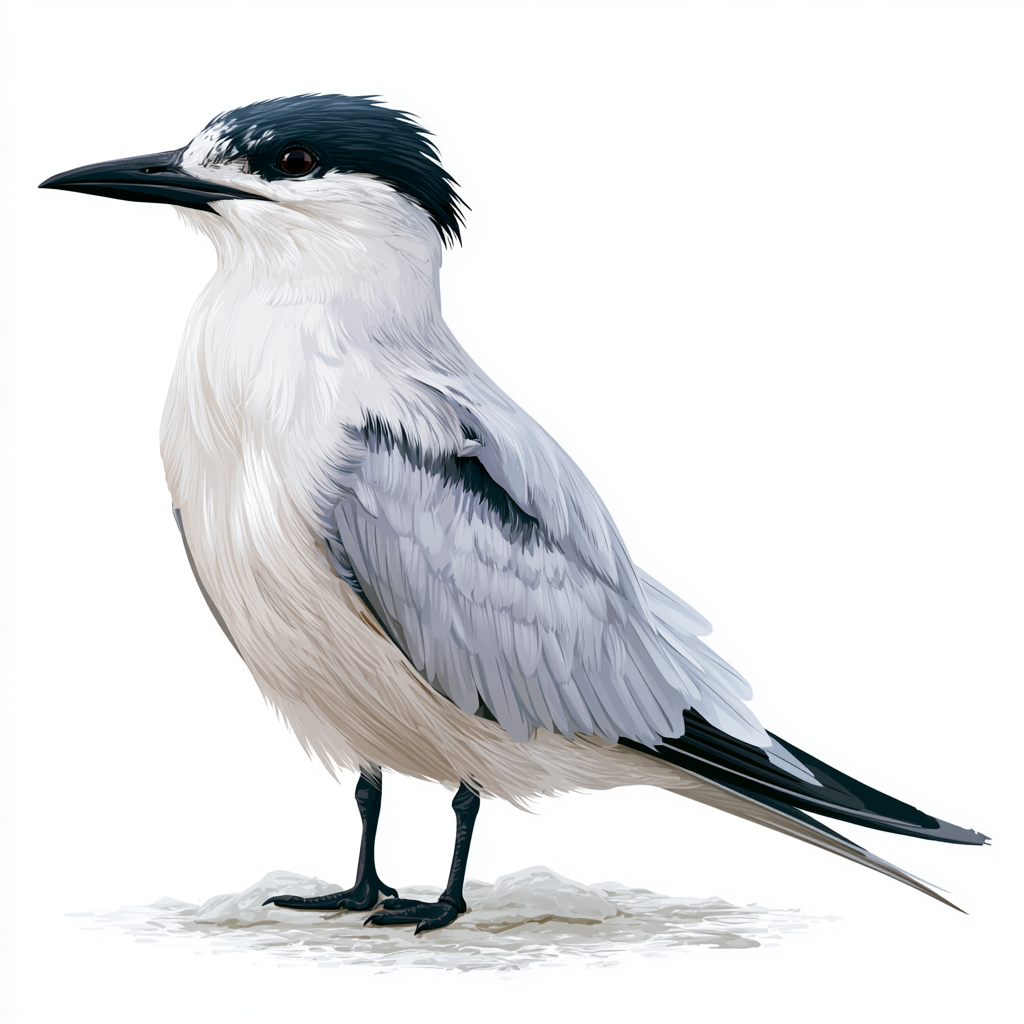
Gull-billed Tern
Gelochelidon nilotica
The Gull-billed Tern is a rare summer visitor to Britain, typically seen in coastal areas, particularly in the southern and eastern regions, from May to September. It is a distinctive tern species that can be spotted in a variety of habitats, including estuaries, marshes, and beaches.
Field Identification Guide
Use these features to identify Gull-billed Tern in the field.
The Gull-billed Tern can be identified by its thick, black bill, grey back, and white forehead, as well as its distinctive black tip to the yellow bill. Its wings and tail are also notable for their dark grey colour with a white trailing edge.
The Gull-billed Tern is slightly larger than a Common Tern, with a more robust build.
The male Gull-billed Tern has a slate-grey back, white underside, and a black crown, with a white forehead and a thick, black bill with a yellow tip.
The female Gull-billed Tern is similar to the male, with no significant differences in plumage.
The Gull-billed Tern has a loud, harsh call, often described as a sharp "krek" or "kek", which is frequently repeated.
The Gull-billed Tern is a ground-nesting species that feeds on a variety of prey, including insects, small fish, and crustaceans, which it catches in flight or by diving into the water. It is known for its agile and swift flight.
The Gull-billed Tern can be confused with the Common Tern, but it can be distinguished by its thicker, black-tipped bill and its more robust build, as well as its grey back and white forehead.
Quick Facts
Who's spotted this?
Loading...
Recent community sightings
Loading recent sightings...


