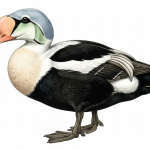
Snowy Owl
Bubo scandiacus
The Snowy Owl is a rare winter visitor to Britain, typically seen in the northern islands and coastal areas, particularly during periods of food scarcity in its native Arctic habitats. It is most likely to be spotted in the UK from October to March, although sightings can occur at any time of the year.
Field Identification Guide
Use these features to identify Snowy Owl in the field.
The Snowy Owl can be identified by its predominantly white plumage, rounded head, and yellow eyes, with females and juveniles showing distinctive dark brown markings on their wings and body. Its white colouration and lack of ear tufts also distinguish it from other owl species.
The Snowy Owl is larger than a Tawny Owl, with a similar size to a large goose, making it one of the biggest owl species to occur in Britain.
The male Snowy Owl has a pure white plumage, although some individuals may show a few faint dark markings, with the overall appearance remaining largely consistent throughout the year.
The female Snowy Owl has a similar white plumage to the male, but with more extensive dark brown flecks and markings, particularly on the wings, back, and belly, which can help to distinguish her from the male.
The Snowy Owl's call is a low, husky "hoo-h'ooh" or "hoo-h'o", often repeated at intervals, with a distinctive, haunting quality that can carry over long distances.
Snowy Owls are diurnal and crepuscular hunters, using their exceptional vision and hearing to catch small mammals, birds, and other prey in the open tundra and coastal habitats, often flying low and slowly over the ground in search of food.
The Snowy Owl can be confused with the Barn Owl, particularly when seen at a distance or in poor light, but its larger size, more rounded head, and lack of ear tufts, as well as its distinctive white plumage, should help to distinguish it from the more common and widespread Barn Owl.
Quick Facts
Who's spotted this?
Loading...
Recent community sightings
Loading recent sightings...