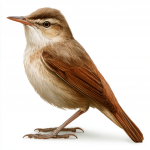
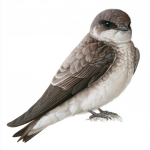
Eastern Kingbird
Tyrannus tyrannus
The Eastern Kingbird is a rare migrant to Britain, typically seen in the summer months, and can be spotted in open areas with scattered trees and bushes. It is more commonly found in its native Americas, but occasional sightings have been recorded in the UK, particularly in the southern regions.
Field Identification Guide
Use these features to identify Eastern Kingbird in the field.
The Eastern Kingbird can be identified by its dark gray upperparts, white underbelly, and pointed wings, as well as its distinctive white tip on the tail. Its gray and white colouration, combined with its large size, makes it a notable sight.
The Eastern Kingbird is larger than a Blue Tit, but smaller than a Starling, with its size being a notable feature when spotting the species.
The male Eastern Kingbird has a dark gray back, wings, and tail, with a white belly and undertail coverts, and a distinctive white tip on the tail, with no significant seasonal variation in its plumage.
The female Eastern Kingbird is similar to the male, with the same dark gray and white colouration, making it difficult to distinguish between the sexes based on plumage alone.
The Eastern Kingbird's call is a sharp, metallic "kip" or "tik", often repeated in a series, while its song is a whistled, musical phrase.
The Eastern Kingbird is a conspicuous and active bird, often perching on exposed branches while foraging for insects, and is known for its agile flight and bold, territorial behaviour.
The Eastern Kingbird can be confused with other flycatchers, such as the Spotted Flycatcher, but can be distinguished by its larger size, darker gray back, and white underbelly, as well as its distinctive white-tipped tail.
Quick Facts
Who's spotted this?
Loading...
Recent community sightings
Loading recent sightings...