Nightjar
Caprimulgus europaeus
The Nightjar is a medium-sized, nocturnal bird that can be seen in Britain during the summer months, typically from May to August, in open woodland areas and heathlands. It is a rare breeding bird in Britain, with sightings mostly confined to the southern parts of England.
Field Identification Guide
Use these features to identify Nightjar in the field.
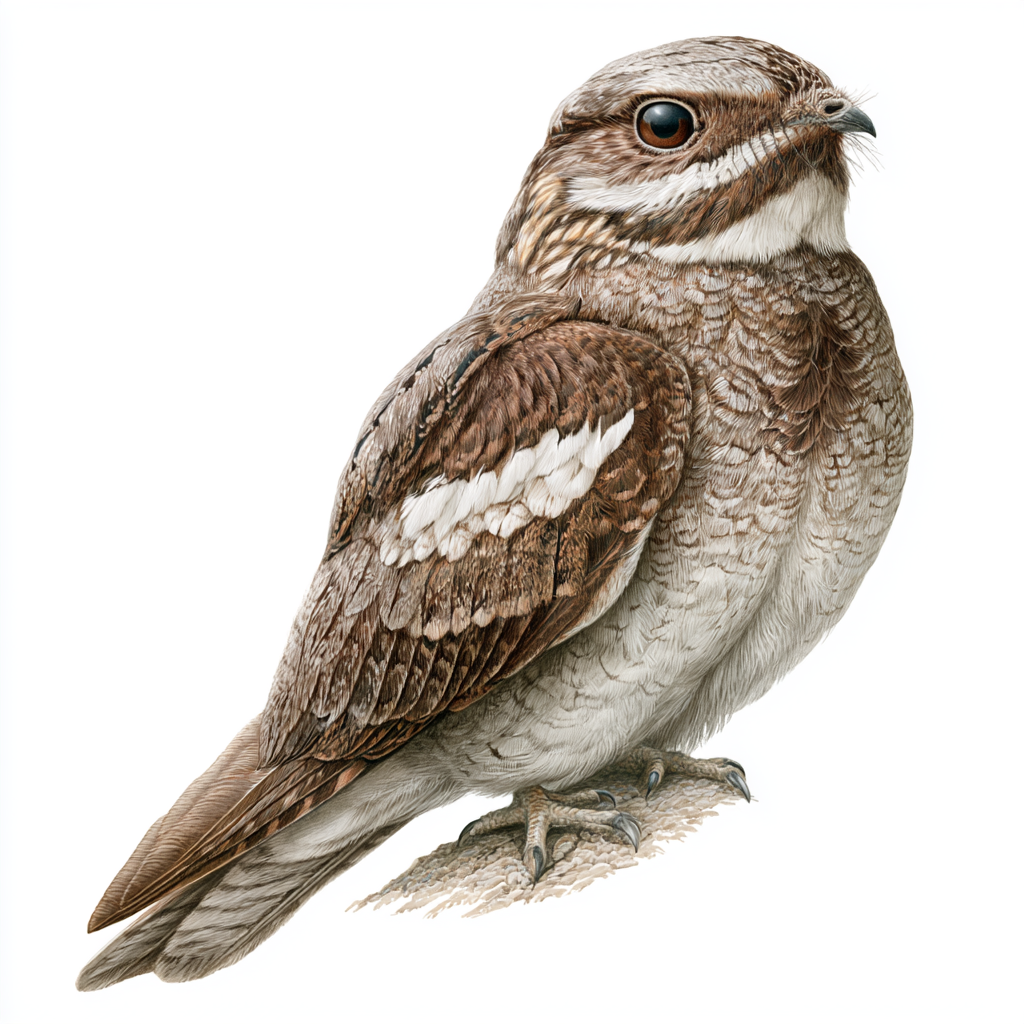
The Nightjar can be identified by its long, pointed wings, short legs, and very short bill, as well as its mottled brown and grey plumage with white patches on the wings and tail. Its overall shape and colouration help to distinguish it from other nocturnal birds.
The Nightjar is slightly larger than a Blackbird, but smaller than a Crow, making it a medium-sized bird that is easily overlooked.
The male Nightjar has a distinctive white patch on its wings and a white tip to its tail, with a overall mottled brown and grey plumage that helps it to blend in with its surroundings.
The female Nightjar is similar to the male, but lacks the white patches on the wings and tail, and has a more subdued colouration overall.
The Nightjar's call is a distinctive, churring sound, often described as a repetitive, mechanical "chur-chur-chur" that can be heard at dusk and dawn.
Nightjars are nocturnal birds that feed on insects in flight, using their long, pointed wings to chase down their prey in a swift and agile manner, and are often seen flying low over the ground with a distinctive, erratic flight pattern.
The Nightjar can be confused with other nocturnal birds, such as the Swift or the Swallow, but its long, pointed wings and short legs help to distinguish it from these species, and its mottled brown and grey plumage sets it apart from the more uniformly coloured Swifts and Swallows.
Quick Facts
Who's spotted this?
Loading...
Recent community sightings
Loading recent sightings...