Common Nighthawk
Chordeiles minor
The Common Nighthawk is a rare migrant to Britain, typically seen during the autumn, with most sightings occurring in the southern and western regions of the country. It is most often spotted near coastal areas, particularly during periods of strong easterly winds.
Field Identification Guide
Use these features to identify Common Nighthawk in the field.
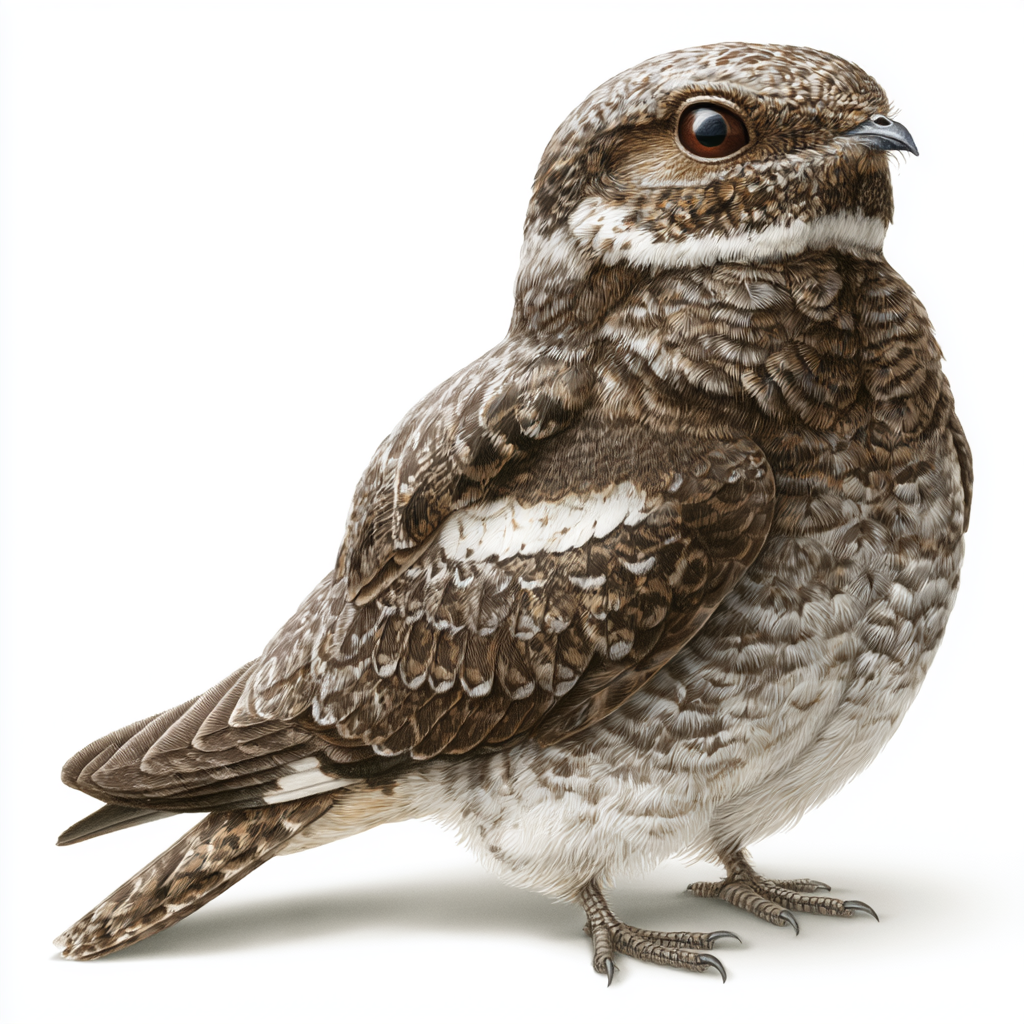
The Common Nighthawk can be identified by its distinctive white throat patch, long pointed wings, and a striking white bar across its wings, which is visible when in flight.
The Common Nighthawk is slightly larger than a Blackbird, but smaller than a Collared Dove.
The male Common Nighthawk has a grey-brown back, wings, and tail, with a white underside and a distinctive white bar on its wings, as well as a white throat patch and a buff-coloured nape.
The female Common Nighthawk is similar to the male, but with a slightly more subdued colouration and a buff-coloured throat patch.
The Common Nighthawk's call is a sharp, nasal "peent" or "peeent" sound, often repeated in a series of 3-5 calls.
Common Nighthawks are crepuscular birds, feeding on insects in flight, often near streetlights or other sources of artificial light, and are known for their agile and swift flight.
The Common Nighthawk can be confused with the Nightjar, but can be distinguished by its more pointed wings, white throat patch, and distinctive white bar on its wings, as well as its more nasal call.
Quick Facts
Who's spotted this?
Loading...
Recent community sightings
Loading recent sightings...