Spanish Sparrow
Passer hispaniolensis
The Spanish Sparrow is a rare visitor to Britain, typically seen in the southern regions during the summer months, and is notable for its resemblance to the House Sparrow. It is more commonly found in the Mediterranean region and south-west Asia, making sightings in Britain a significant event for birdwatchers.
Field Identification Guide
Use these features to identify Spanish Sparrow in the field.
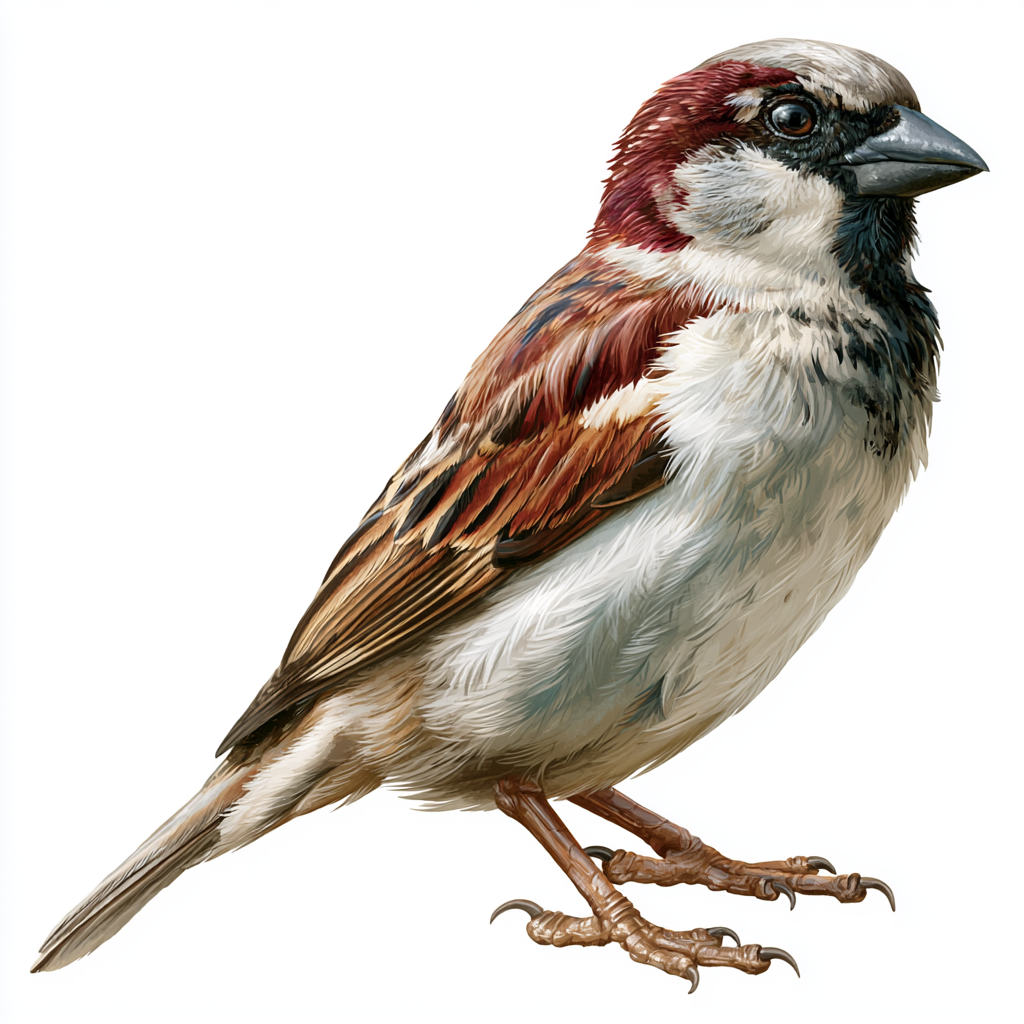
The Spanish Sparrow can be identified by its black throat patch, chestnut crown, and white cheeks, which distinguish it from other sparrow species. Its grey-brown back and wings also feature distinctive black streaks, and its bill is black and conical in shape.
The Spanish Sparrow is slightly larger than a House Sparrow, but smaller than a Starling, making it a medium-sized passerine bird.
The male Spanish Sparrow has a distinctive black throat patch, chestnut crown, and white cheeks, with a grey-brown back and wings featuring black streaks, and a black bill. Its plumage remains relatively consistent throughout the year, with minimal seasonal variation.
The female Spanish Sparrow is similar to the male, but with a less pronounced throat patch and duller colours, making it more challenging to distinguish from other female sparrow species.
The Spanish Sparrow's call is a series of sharp, chirping notes, often described as a loud and melodic "chep-chepe-chepe", while its song is a more complex and musical series of phrases.
Spanish Sparrows are social birds that forage for seeds, insects, and fruits in a variety of habitats, including urban areas, farmland, and wetlands, often flying in flocks and exhibiting a swift, direct flight style.
The Spanish Sparrow can be confused with the House Sparrow, but can be distinguished by its black throat patch, chestnut crown, and white cheeks, as well as its more subdued colouration and lack of a distinctive black stripe on the chest.
Quick Facts
Who's spotted this?
Loading...
Recent community sightings
Loading recent sightings...