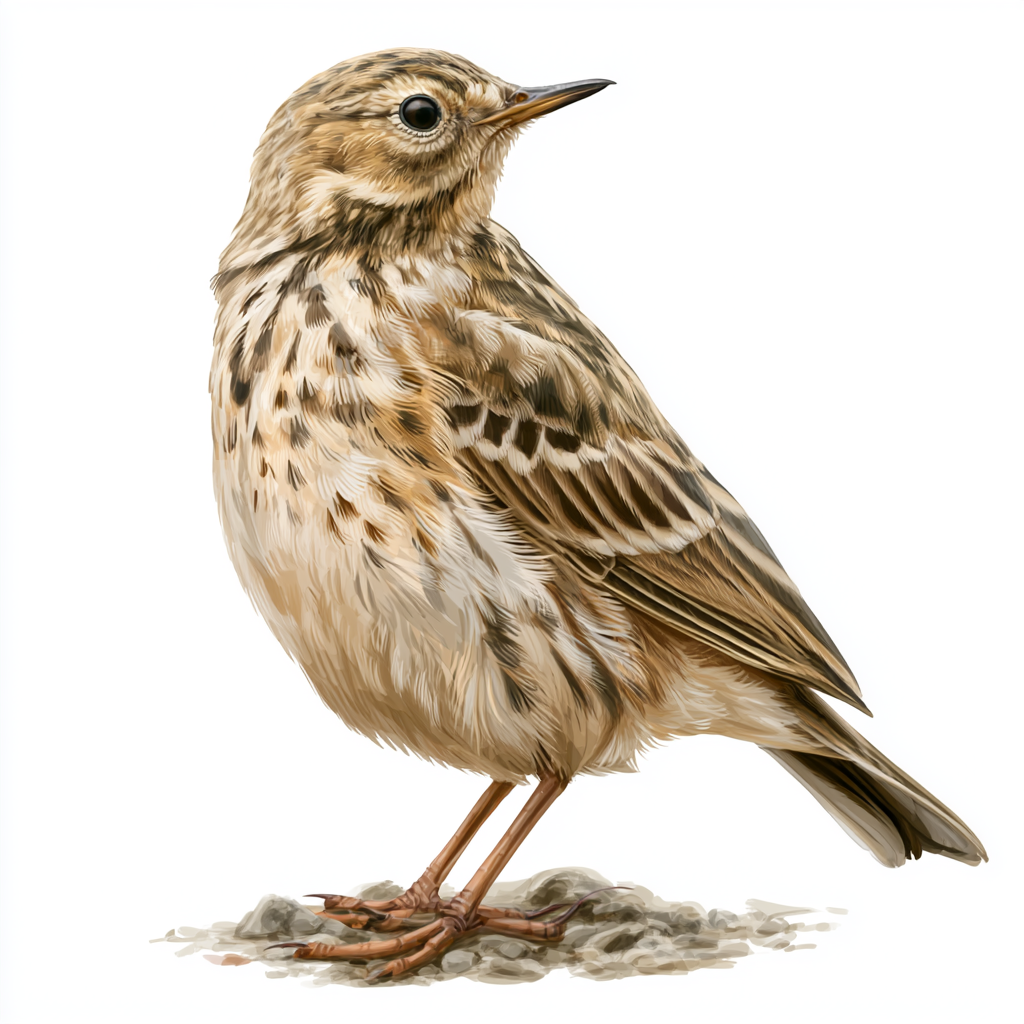
Meadow Pipit
Anthus pratensis
The Meadow Pipit is a common and widespread species in Britain, found in a variety of open habitats including moorlands, grasslands, and wetlands, and can be seen throughout the year, although numbers may increase in winter with the arrival of migrants from northern and eastern Europe. It is a familiar sight in many parts of the country, particularly in rural areas.
Field Identification Guide
Use these features to identify Meadow Pipit in the field.
The Meadow Pipit can be identified at a glance by its streaked breast and flanks, brownish-grey back, and white outer tail feathers, as well as its distinctive white eye-ring and pale stripe above the eye. Its legs are pinkish-brown and relatively long.
The Meadow Pipit is slightly smaller than a Starling, measuring around 12-14 cm in length, and is larger than a Blue Tit.
The male Meadow Pipit has a brownish-grey back and wings, with a streaked breast and flanks, and a white belly, with little seasonal variation in its plumage, although it may appear more worn in the summer months.
The female Meadow Pipit is similar to the male, with the same overall pattern and colouration, although it may be slightly duller and more subdued.
The Meadow Pipit's call is a sharp, metallic "tzee" or "tsee", often repeated in a series, while its song is a series of descending phrases, often described as a melancholic, whistling tune.
The Meadow Pipit is a ground-foraging bird, feeding on a variety of invertebrates, seeds, and fruits, and is often seen walking or running on the ground, although it will also fly up to perch on a fence post or bush to sing or survey its surroundings.
The Meadow Pipit can be confused with the Tree Pipit and the Rock Pipit, but can be distinguished from these species by its more streaked breast and flanks, and its white outer tail feathers, as well as its habitat preferences, with the Tree Pipit favouring woodland edges and the Rock Pipit found in more coastal and rocky areas.
Quick Facts
Who's spotted this?
Loading...
Recent community sightings
Loading recent sightings...


