Water Pipit
Anthus spinoletta
The Water Pipit is a rare winter visitor to Britain, typically seen in wet open lowlands and coastal areas, with sightings most likely from October to March. It is more commonly associated with the mountains of Southern Europe and the Palearctic, where it breeds during the summer months.
Field Identification Guide
Use these features to identify Water Pipit in the field.
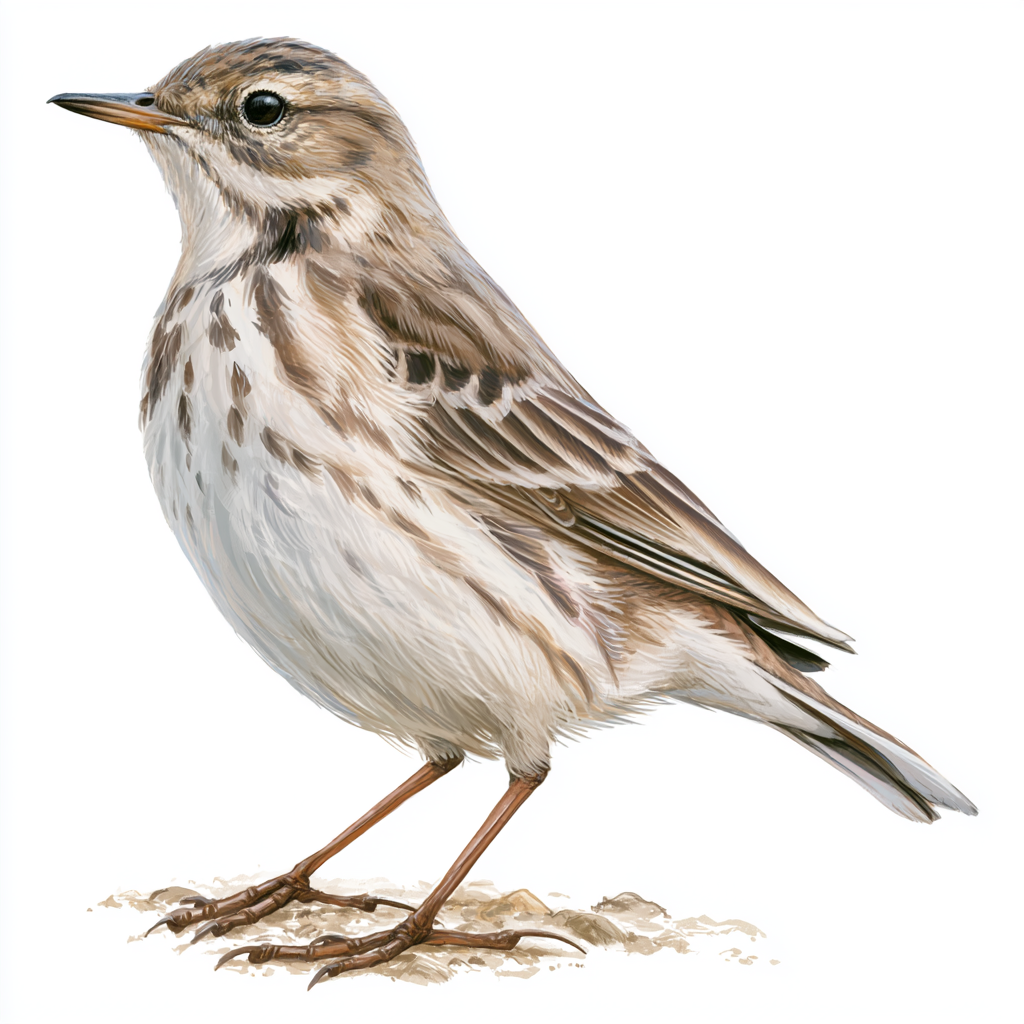
The Water Pipit can be identified by its streaked breast and flanks, pale yellowish-buff underside, and distinctive white outer tail feathers. Its brownish-grey upperparts and white wing bars are also notable features.
The Water Pipit is slightly smaller than a Meadow Pipit, and larger than a Blue Tit.
The male Water Pipit has a brownish-grey back and wings, with a pale yellowish-buff breast and belly, and distinctive dark streaks on its breast and flanks, with some seasonal variation in the intensity of these markings.
The female Water Pipit is similar to the male, with similar plumage and markings, although possibly slightly duller in colour.
The Water Pipit's call is a sharp, high-pitched "tzeep" or "tzee", often repeated in a series, while its song is a series of short, melodic phrases.
The Water Pipit is a ground-dwelling bird that feeds on small invertebrates, seeds, and plants, often running or walking rather than flying, and when in flight, it has a characteristic weak, fluttering style.
The Water Pipit can be confused with the Rock Pipit and Meadow Pipit, but can be distinguished by its pale yellowish-buff underside, streaked breast, and white outer tail feathers, which are not found in the other two species.
Quick Facts
Who's spotted this?
Loading...
Recent community sightings
Loading recent sightings...