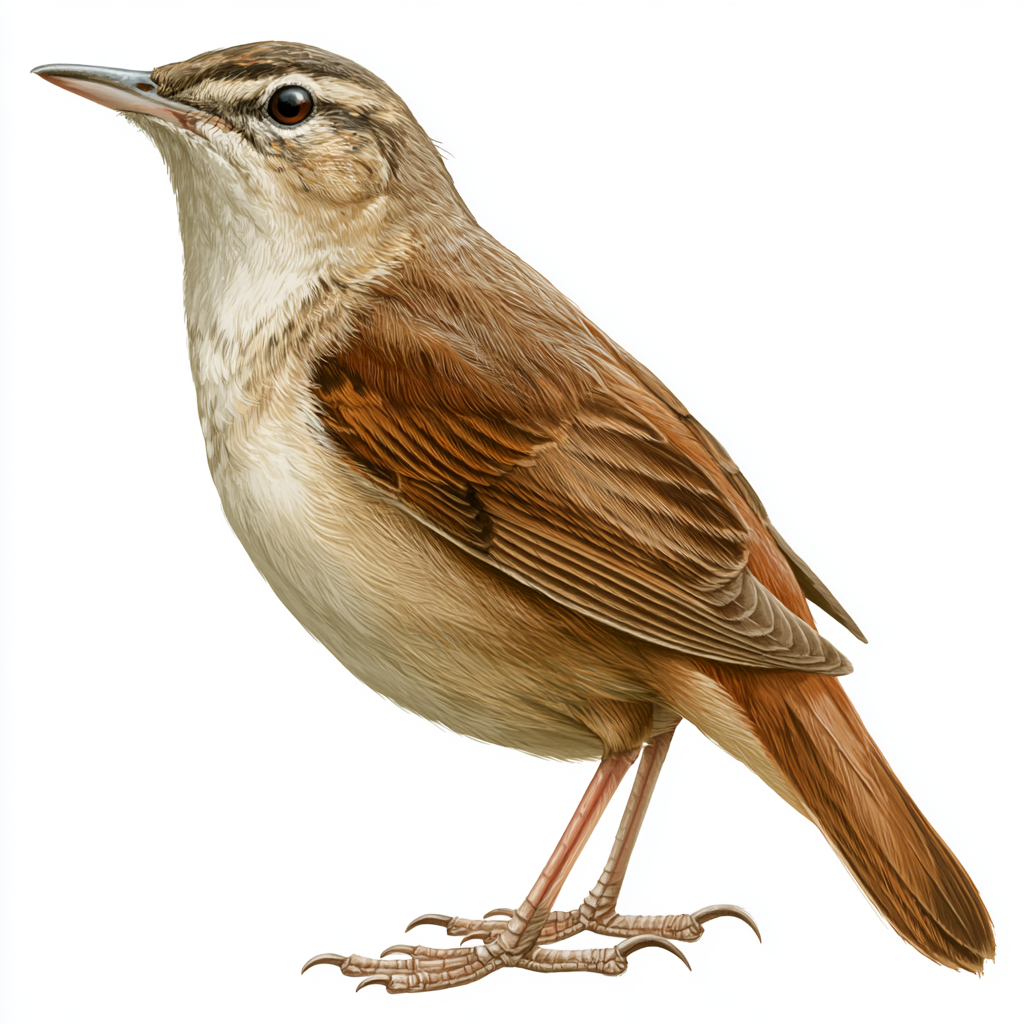
Savi’s Warbler
Locustella luscinioides
Savi's Warbler is a rare migrant in Britain, typically seen during the spring and autumn, with most sightings occurring in the southern and eastern regions. It is a skulking species, often found in dense vegetation, making it a challenging bird to spot.
Field Identification Guide
Use these features to identify Savi’s Warbler in the field.
The Savi's Warbler can be identified by its broad, rounded tail, long undertail coverts, and a distinctive whitish stripe above its eye. Its overall appearance is also characterized by a dull brown back and wings.
The Savi's Warbler is slightly smaller than a House Sparrow, with a more compact build.
The male Savi's Warbler has a dull brown plumage with a greyish-brown crown, and a pale greyish-brown breast and belly, with little to no seasonal variation.
The female Savi's Warbler is similar to the male, with no notable differences in plumage.
The Savi's Warbler's call is a low, rasping "krek" or "chrek" sound, often repeated in a series, while its song is a monotonous, insect-like buzzing.
Savi's Warblers are secretive birds, often feeding on insects and spiders in dense vegetation, and when flushed, they fly low and swiftly, usually dropping back into cover quickly.
The Savi's Warbler can be confused with other Locustella species, such as the Grasshopper Warbler, but can be distinguished by its broader tail and longer undertail coverts, as well as its distinctive call and song.
Quick Facts
Who's spotted this?
Loading...
Recent community sightings
Loading recent sightings...


