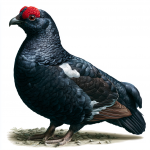
Rustic Bunting
Emberiza rustica
The Rustic Bunting is a rare but occasional winter visitor to Britain, typically seen in the northern and eastern regions, particularly in areas with dense vegetation and seed-bearing plants. It is most likely to be spotted from October to April, with the majority of sightings occurring during the late autumn and early winter months.
Field Identification Guide
Use these features to identify Rustic Bunting in the field.
The Rustic Bunting can be identified by its distinctive head pattern, featuring a dark brown crown and white eyebrow stripe, as well as its reddish-brown back and wings, and a long, notched tail. Its pale underside with dark streaks is also a key identification feature.
The Rustic Bunting is slightly smaller than a Starling, measuring around 12-14 cm in length.
The male Rustic Bunting has a distinctive breeding plumage, characterized by a dark brown crown, white eyebrow stripe, and reddish-brown back and wings, with a pale underside featuring dark streaks, although in Britain, it is typically seen in its duller winter plumage.
The female Rustic Bunting is similar to the male but has a more subdued colouration, with a browner back and less distinct head pattern, making it more challenging to identify.
The Rustic Bunting's call is a sharp, metallic "tik" or "tek" sound, while its song is a series of short, melodic phrases, often described as a repetitive, whistled tune.
The Rustic Bunting is a ground-dwelling bird that feeds on seeds, grains, and insects, often foraging in dense vegetation and undergrowth, and is known for its skulking behaviour, making it difficult to spot.
The Rustic Bunting can be confused with other bunting species, such as the Little Bunting and the Yellowhammer, but can be distinguished by its distinctive head pattern, reddish-brown back, and long, notched tail.
Quick Facts
Who's spotted this?
Loading...
Recent community sightings
Loading recent sightings...