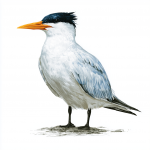
Marmora’s Warbler
Curruca sarda
Marmora's Warbler is a rare migrant to Britain, typically seen in the southern regions during the spring and autumn, with most sightings occurring on the Isles of Scilly and in Cornwall. It is a species that breeds in the Mediterranean region, making its appearances in Britain infrequent and often associated with easterly winds.
Field Identification Guide
Use these features to identify Marmora’s Warbler in the field.
The Marmora's Warbler can be identified by its grey-brown back, white underside, and distinctive white eye-ring, as well as its relatively long tail and rounded wings. Its head pattern, featuring a dark stripe through the eye, is also a key identification feature.
The Marmora's Warbler is slightly smaller than a Blackcap, making it a relatively compact bird.
The male Marmora's Warbler has a grey-brown upperpart, a white belly, and a pale yellow breast with a grey-brown stripe above, with little seasonal variation in its plumage.
The female Marmora's Warbler is similar to the male, although it may appear slightly duller in colour, particularly on the breast and flanks.
The Marmora's Warbler has a sharp, scratchy call, often described as a loud "tak" or "tchak", and its song is a series of short, melodic phrases.
Marmora's Warblers are skulking birds, often feeding on the ground or in low vegetation, and they have a distinctive, jerky flight style, frequently darting between bushes.
The Marmora's Warbler can be confused with other warbler species, such as the Subalpine Warbler, but it can be distinguished by its grey-brown back, white eye-ring, and the lack of a bright yellow or orange colour on its breast and head.
Quick Facts
Who's spotted this?
Loading...
Recent community sightings
Loading recent sightings...