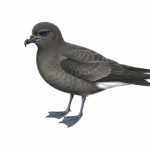
American Cliff Swallow
Petrochelidon pyrrhonota
The American Cliff Swallow is a rare migrant to Britain, typically seen during the summer months, and is notable for its distinctive appearance and colonial breeding habits. It can be spotted in coastal areas, particularly around cliffs and rocky outcrops, although sightings are infrequent and often associated with vagrant individuals.
Field Identification Guide
Use these features to identify American Cliff Swallow in the field.
The American Cliff Swallow can be identified by its dark brown back, white forehead, and reddish-brown rump, as well as its distinctive white markings on the forehead and a squared-off tail. Its dark throat patch and pale underside also help to distinguish it from other swallow species.
The American Cliff Swallow is slightly smaller than a House Martin, with a more compact body and shorter tail.
The male American Cliff Swallow has a dark brown back, wings, and tail, with a white forehead, white underside, and a reddish-brown rump, and its plumage remains relatively consistent throughout the year.
The female American Cliff Swallow is similar to the male, with slightly less intense colouration and a browner tone to the back and wings.
The American Cliff Swallow's call is a sharp, high-pitched "chee-chee-chee" or "chip-chip-chip", often repeated in a series of short phrases.
American Cliff Swallows are social birds that feed on insects in mid-air, using their agile flight and sharp eyesight to catch prey, and are known for their colonial breeding habits, often nesting in large groups on cliffs and rock faces.
The American Cliff Swallow can be confused with the Barn Swallow, but can be distinguished by its darker back, white forehead, and reddish-brown rump, as well as its more compact body and shorter tail.
Quick Facts
Who's spotted this?
Loading...
Recent community sightings
Loading recent sightings...