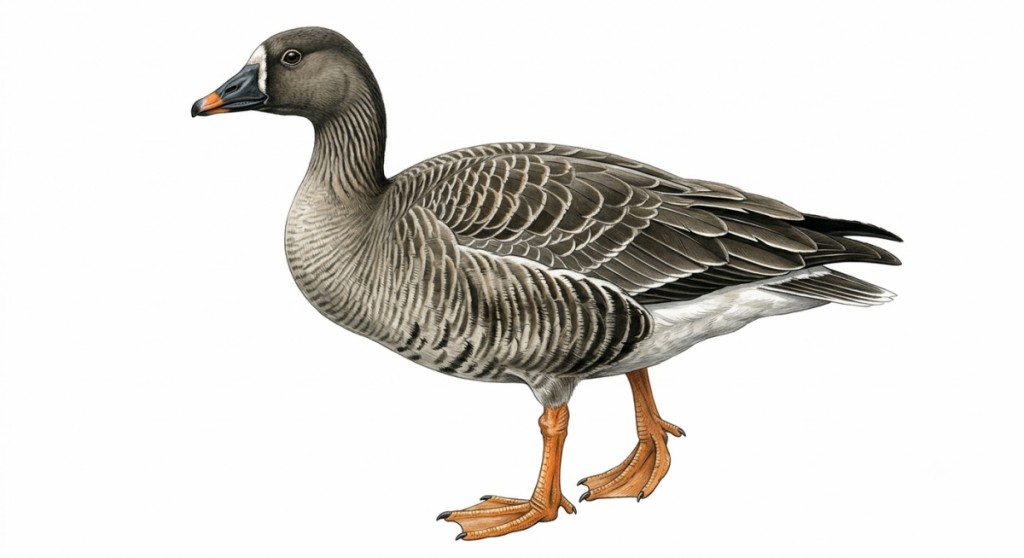
Tundra Bean Goose
Anser serrirostris
The Tundra Bean Goose is a rare migrant in Britain, typically seen during spring and autumn, with most sightings occurring in eastern and southern England. It is a distinctive species that can be spotted in wetlands, estuaries, and coastal areas, often in small flocks.
Field Identification Guide
Use these features to identify Tundra Bean Goose in the field.
The Tundra Bean Goose can be identified by its broad, orange-yellow bill, dark brown head and neck, and pale grey-brown body, as well as its distinctive black barring on its breast and belly. Its white patches on the forehead and forecrown are also notable features.
The Tundra Bean Goose is larger than a Greylag Goose, with a similar size to a Pink-footed Goose, making it a substantial bird in the field.
The male Tundra Bean Goose has a dark brown head and neck, with a pale grey-brown body, white patches on the forehead and forecrown, and black barring on its breast and belly, with little seasonal variation in its plumage.
Similar to the male, the female Tundra Bean Goose has the same plumage pattern, with no notable differences in colour or markings.
The Tundra Bean Goose has a loud, honking call, often described as a deep, resonant "honk-honk-honk", which can be heard during migration and at breeding sites.
The Tundra Bean Goose is a migratory species that feeds on grasses, leaves, and aquatic plants, often in wet meadows and coastal areas, and can be seen flying in V-formation during migration, with a steady, direct flight style.
The Tundra Bean Goose can be confused with the Taiga Bean Goose, but can be distinguished by its broader, more orange-yellow bill, and darker head and neck, as well as its more extensive black barring on its breast and belly.
Quick Facts
Who's spotted this?
Loading...
Recent community sightings
Loading recent sightings...


