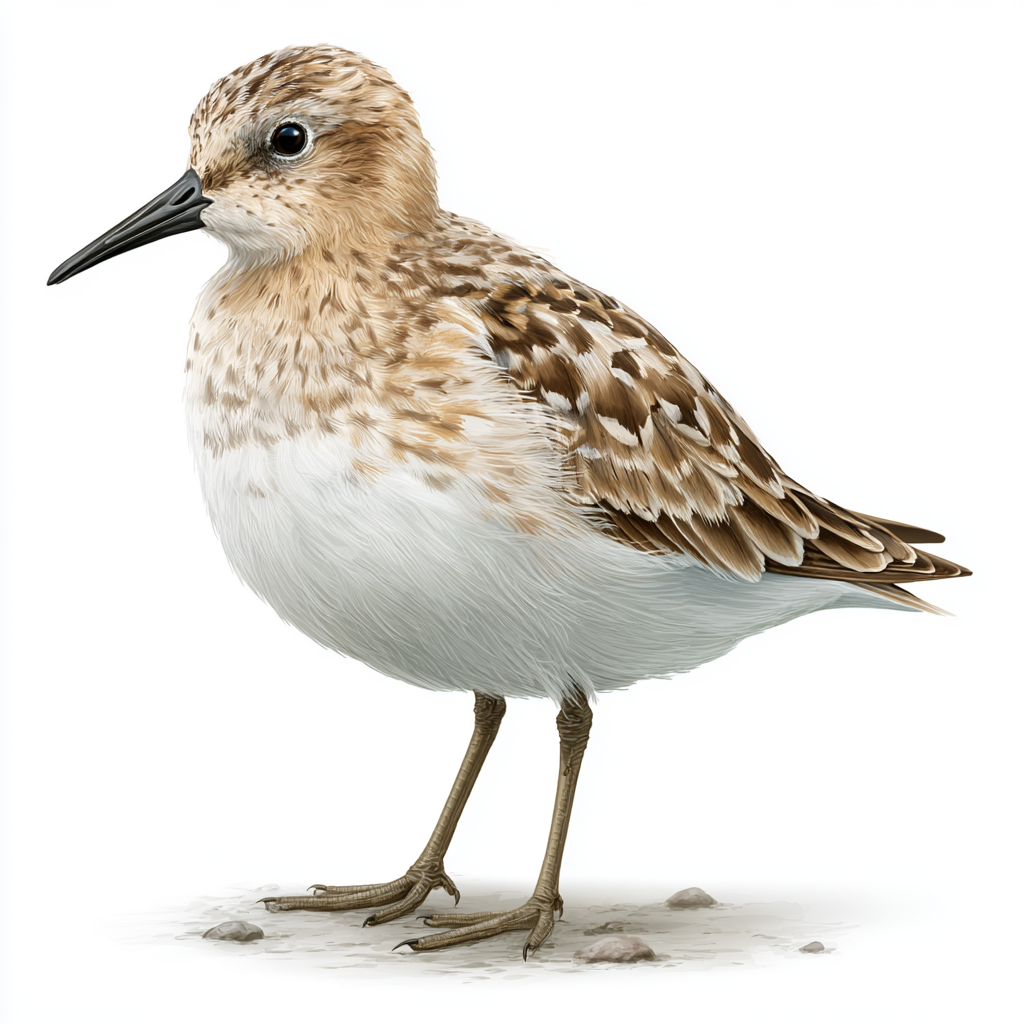
Baird’s Sandpiper
Calidris bairdii
The Baird's Sandpiper is a rare migrant to Britain, typically seen during the autumn, with most sightings occurring in the western and northern parts of the country. It can be found on a variety of wetland habitats, including estuaries, marshes, and muddy pools.
Field Identification Guide
Use these features to identify Baird’s Sandpiper in the field.
This species can be identified by its distinctive black stripe running across its forehead, a long black bill, and a black stripe on its back, which contrasts with its brownish-grey plumage.
The Baird's Sandpiper is smaller than a Starling, measuring around 18-20 cm in length.
The male's plumage is a mottled brown and grey, with a black stripe running across its forehead and a black stripe on its back, and it has a whitish belly, with some individuals showing a reddish-brown hue on their crowns and breasts during the breeding season.
The female's plumage is similar to the male's, although it may be slightly duller in colour, particularly outside of the breeding season.
The Baird's Sandpiper's call is a high-pitched, whistled "pee-wee" or "chee-wee" sound, often repeated in a series.
This species is a probing feeder, using its long bill to search for small invertebrates in mud and wet soil, and it is often seen running or walking quickly as it forages, with a distinctive flight style characterized by rapid wingbeats.
The Baird's Sandpiper can be confused with other small Calidris species, such as the White-rumped Sandpiper and the Pectoral Sandpiper, but it can be distinguished by its black forehead stripe and lack of a white rump patch.
Quick Facts
Who's spotted this?
Loading...
Recent community sightings
Loading recent sightings...