Wallcreeper
Tichodroma muraria
The Wallcreeper is a rare and elusive visitor to Britain, typically spotted in the summer months in the highest mountainous regions, particularly in the Scottish Highlands and Welsh mountains. It is most often seen scaling vertical rock faces in search of insects and spiders.
Field Identification Guide
Use these features to identify Wallcreeper in the field.
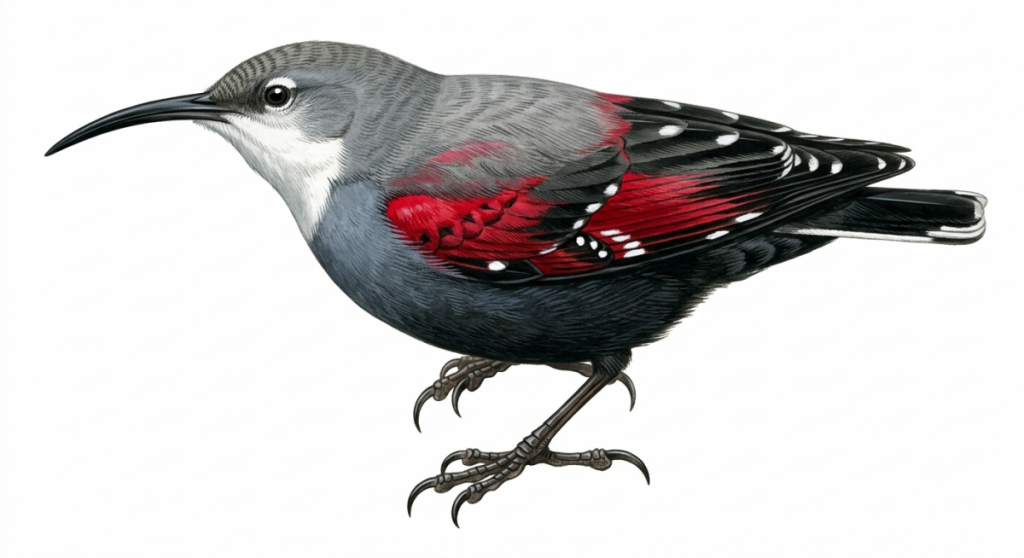
The Wallcreeper's distinctive white wing bars, black throat patch, and crimson wings make it a striking sight, while its slender body and long, curved claws allow it to climb and perch on rocky surfaces. Its grey-brown back and white underside also help to distinguish it from other species.
The Wallcreeper is slightly smaller than a Robin, with a slender build that allows it to navigate narrow rock crevices and ledges.
The male Wallcreeper's plumage is characterized by a grey-brown back, white underside, and distinctive crimson wings with white bars, with little seasonal variation in its appearance.
The female Wallcreeper's plumage is similar to that of the male, with the same grey-brown and white colouration, although it may appear slightly duller in tone.
The Wallcreeper's call is a high-pitched, repetitive "tee-tee-tee" or "tsee-tsee-tsee", often heard as it flits between rocks and crevices.
The Wallcreeper's feeding behaviour involves scaling vertical rock faces in search of insects and spiders, using its long, curved claws and agile body to navigate narrow ledges and crevices, while its flight style is rapid and direct, often with a flicking or fluttering motion.
The Wallcreeper might be confused with the White-throated Dipper or the Black Redstart, but can be distinguished by its distinctive crimson wings, white wing bars, and grey-brown back, as well as its unique climbing behaviour and habitat preferences.
Quick Facts
Who's spotted this?
Loading...
Recent community sightings
Loading recent sightings...