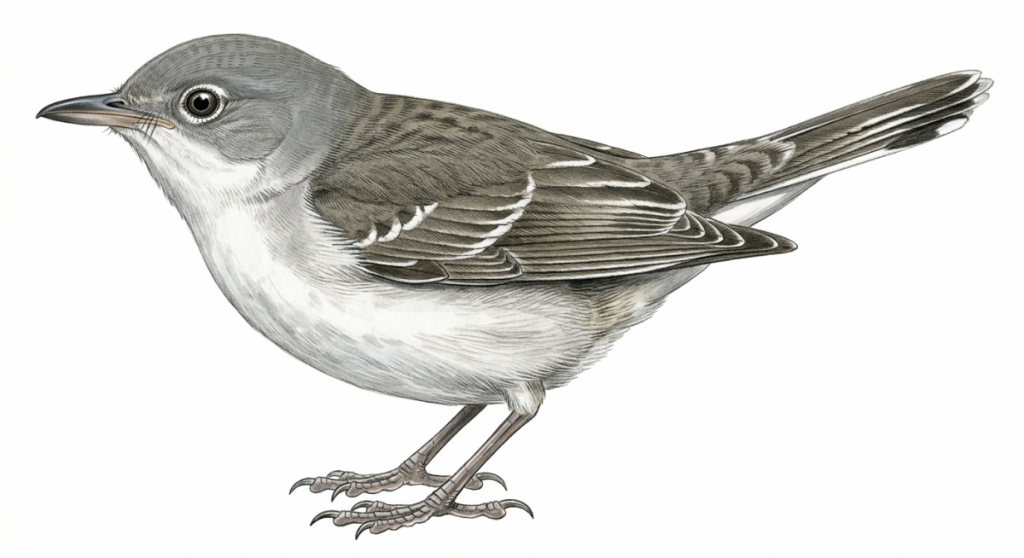
Barred Warbler
Curruca nisoria
The Barred Warbler is a rare migrant to Britain, typically seen during the spring and autumn migration periods, particularly in the eastern and southern regions of the country. It is most often encountered in dense vegetation, such as thickets and hedgerows, where it can be difficult to spot.
Field Identification Guide
Use these features to identify Barred Warbler in the field.
The Barred Warbler can be identified by its distinctive white eye-ring, grey-brown upperparts, and white underparts with dark barring on the breast and flanks. Its white throat patch and lack of wing bars are also notable features.
The Barred Warbler is slightly smaller than a House Sparrow, with a compact and rounded body shape.
The male Barred Warbler has a grey-brown back and wings, with a white throat patch and dark barring on the breast and flanks, while its belly and undertail coverts are white.
The female Barred Warbler is similar to the male, with slightly less intense barring on the breast and flanks.
The Barred Warbler's call is a sharp, metallic "tak" or "tek" sound, while its song is a series of short, melodic phrases often described as scratchy and repetitive.
The Barred Warbler is a skulking species, often feeding on insects and spiders in dense vegetation, and can be seen making short, darting flights between bushes and trees.
The Barred Warbler can be confused with the Garden Warbler, but can be distinguished by its white eye-ring, grey-brown upperparts, and dark barring on the breast and flanks, which are all lacking in the Garden Warbler.
Quick Facts
Who's spotted this?
Loading...
Recent community sightings
Loading recent sightings...


