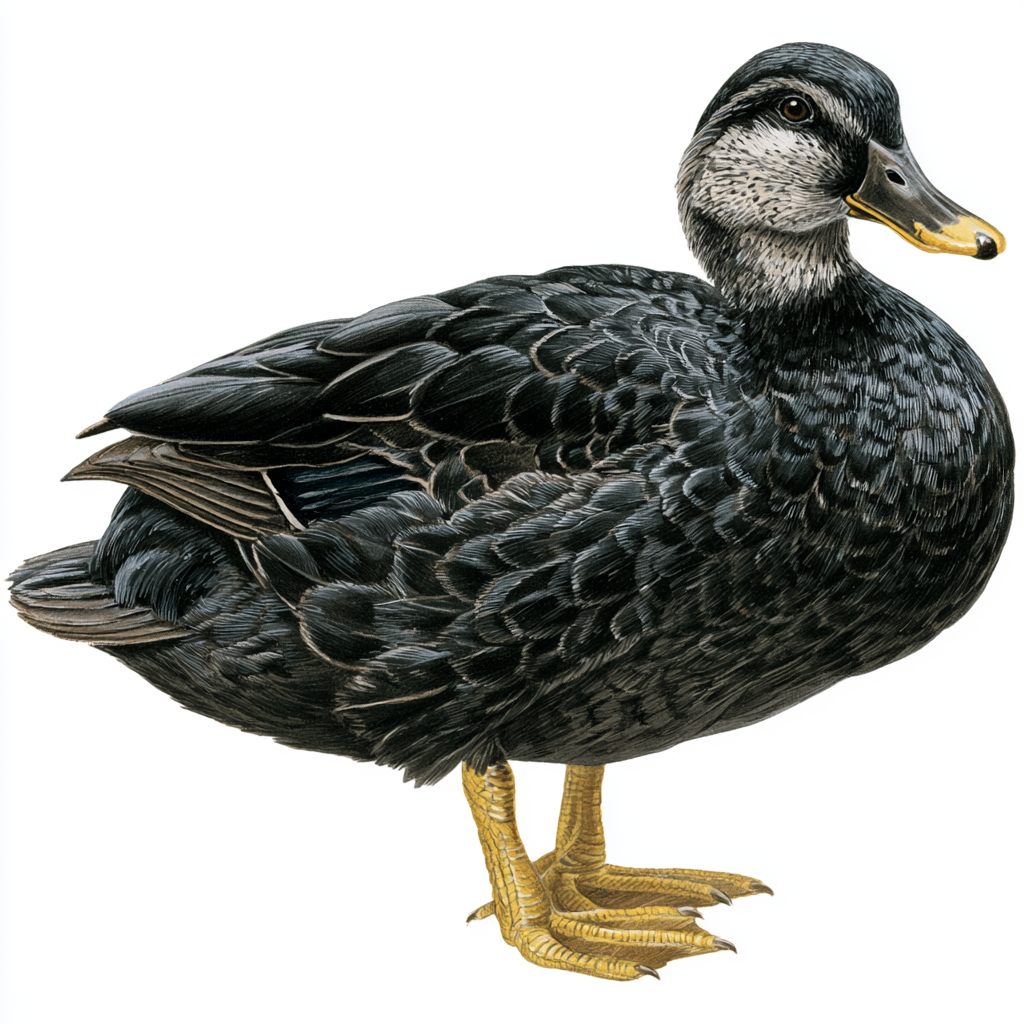
Black Duck
Anas rubripes
The Black Duck is a rare but occasional visitor to Britain, typically seen in the winter months or as a vagrant, often in coastal areas or near wetlands. It is more commonly found in North America, but individuals may wander to British shores, particularly in the northern and western regions.
Field Identification Guide
Use these features to identify Black Duck in the field.
The Black Duck can be identified by its dark brown to black plumage, purple speculum, and orange-red legs and feet. Its broad, flat head and heavy body shape also distinguish it from other duck species.
The Black Duck is slightly larger than a Mallard, with a similar size and build to a Wigeon.
The male Black Duck has a glossy black head, neck, and breast, with a dark brown to black body, and a purple speculum with white borders, although the extent of black versus brown can vary.
The female Black Duck is similar to the male but has a browner tone to her body and head, with a less glossy appearance, making her slightly more difficult to distinguish from female Mallards.
The Black Duck's call is a loud, nasal "quack" or "krek", often repeated, and is similar to that of the Mallard but with a slightly more raspy tone.
Black Ducks are dabbling ducks that feed on aquatic plants, insects, and small invertebrates, often in shallow water or on mudflats, and are known for their swift, direct flight style.
The Black Duck can be confused with the female Mallard, but can be distinguished by its darker plumage, broader head, and orange-red legs, as well as its more nasal call.
Quick Facts
Who's spotted this?
Loading...
Recent community sightings
Loading recent sightings...

