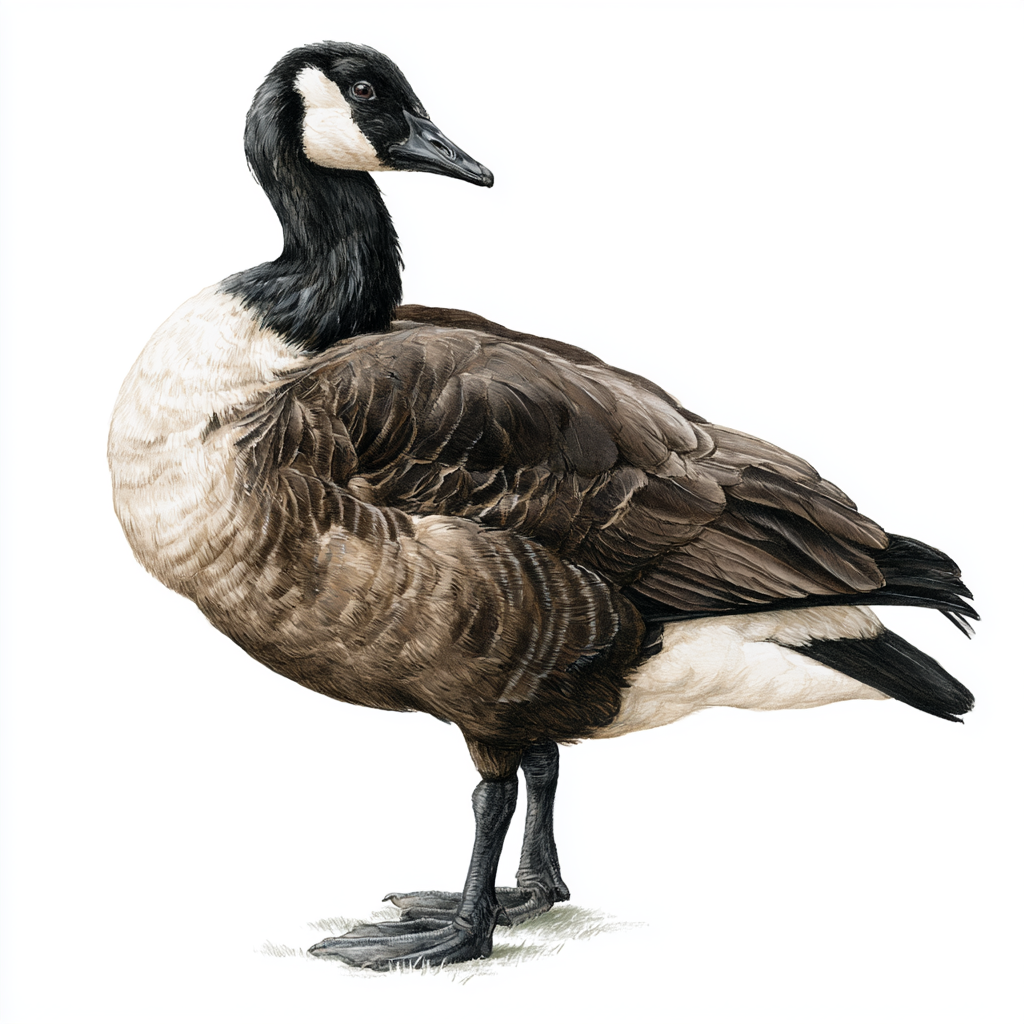
Canada Goose
Branta canadensis
The Canada Goose is a common sight in Britain, particularly in urban parks, grasslands, and wetlands, with a large population established after being introduced to the country. It can be seen throughout the year, although migrant birds from Northern Europe may pass through during spring and autumn.
Field Identification Guide
Use these features to identify Canada Goose in the field.
The Canada Goose is recognizable by its black head and neck, white cheek patches, and brownish-grey body, with a distinctive white patch under the chin. Its broad, flat beak and long, black neck are also notable features.
The Canada Goose is larger than a Greylag Goose, with adults reaching lengths of up to 100 cm, making it one of the larger waterfowl species in Britain.
The male Canada Goose has a black head, neck, and beak, with a brownish-grey back, wings, and belly, and white patches on the cheeks and under the chin, with no significant seasonal variation in plumage.
The female Canada Goose is similar to the male, with the same black head, neck, and beak, and brownish-grey body, although she may be slightly smaller and have a more subdued colouration.
The Canada Goose has a loud, honking call, often transcribed as "honk-honk" or "ka-honk", which is frequently heard in flight or when the birds are alarmed.
Canada Geese are herbivores, feeding on grasses, aquatic plants, and grains, and are often seen grazing in fields or swimming in wetlands, with a distinctive waddling gait on land and a strong, direct flight.
The Canada Goose can be confused with the Greylag Goose, but can be distinguished by its black neck and head, white cheek patches, and more brownish-grey body, whereas the Greylag Goose has a greyish-brown neck and head, and a more pinkish beak.
Quick Facts
Who's spotted this?
Loading...
Recent community sightings
Loading recent sightings...


