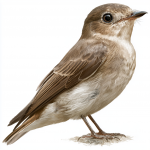
Eastern Phoebe
Sayornis phoebe
The Eastern Phoebe is a rare migrant to Britain, typically seen during the autumn months, and is most often recorded on the eastern and southern coasts. It is a small passerine bird that is more commonly found in North America, making sightings in Britain a notable event for birdwatchers.
Field Identification Guide
Use these features to identify Eastern Phoebe in the field.
The Eastern Phoebe can be identified by its grey-brown back, white belly, and black head with a distinctive black stripe above its beak, as well as its pale yellow belly and lack of distinctive wing bars. Its overall appearance is sleek and streamlined, with a medium-length tail.
The Eastern Phoebe is smaller than a Starling, measuring around 15-17 cm in length, and is comparable in size to a House Sparrow.
The male Eastern Phoebe has a grey-brown back, white belly, and a black head with a black stripe above its beak, with a pale yellow wash on its belly, and its plumage remains relatively consistent throughout the year.
The female Eastern Phoebe is similar to the male, with the same grey-brown back, white belly, and black head, although her colours may be slightly duller.
The Eastern Phoebe's call is a sharp, repetitive "fee-bee" or "phoe-bee" sound, which is often used for communication and contact between birds.
The Eastern Phoebe is an active and agile bird, often seen flying low over water or perched on a branch, where it will dart out to catch insects in mid-air, and it is known for its bold and curious nature.
The Eastern Phoebe can be confused with the Pied Flycatcher or the Spotted Flycatcher, but can be distinguished by its lack of distinctive wing bars and its pale yellow belly, as well as its distinctive call and grey-brown back.
Quick Facts
Who's spotted this?
Loading...
Recent community sightings
Loading recent sightings...