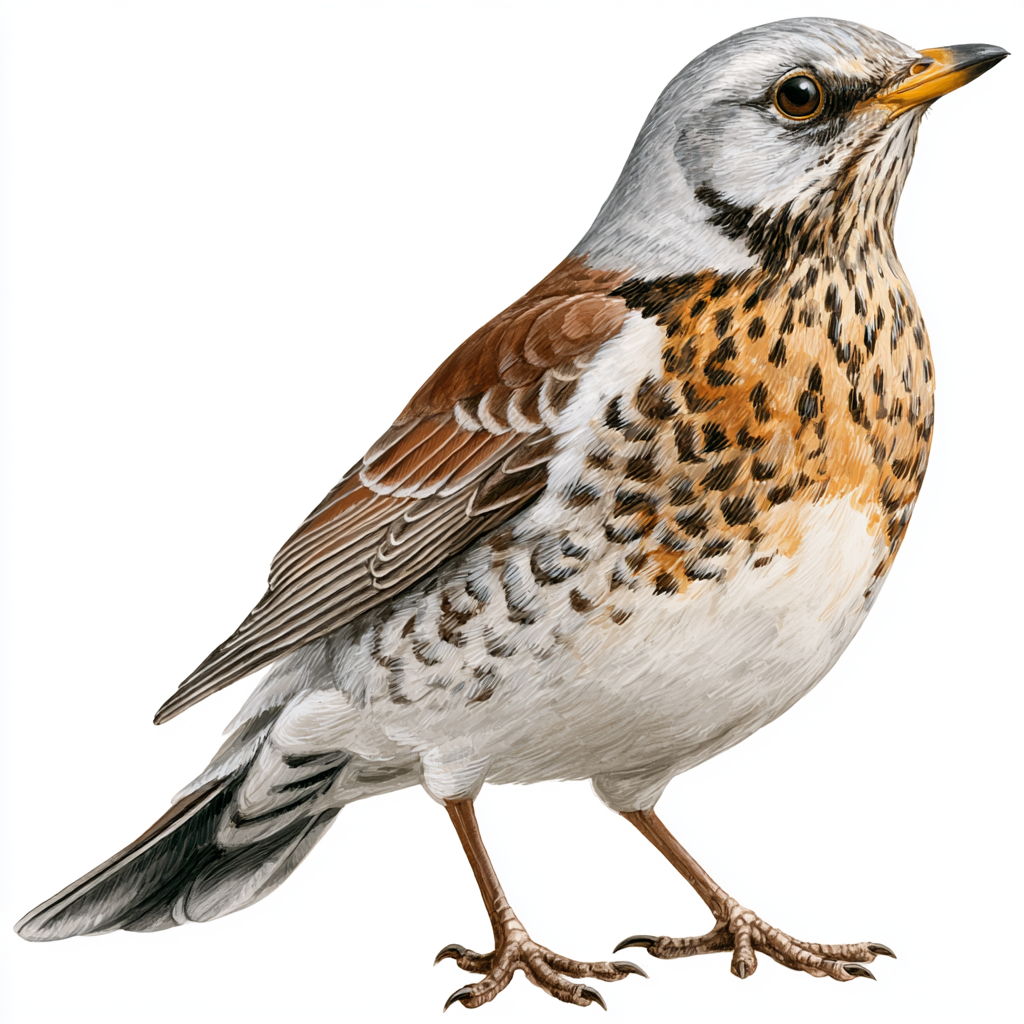
Fieldfare
Turdus pilaris
The Fieldfare is a rare breeder in the British Isles, but it can be seen in large numbers during the winter months, particularly in open countryside and farmland. It is most commonly spotted from October to March, with flocks often forming in areas with abundant food sources.
Field Identification Guide
Use these features to identify Fieldfare in the field.
The Fieldfare can be identified by its grey-brown back, chestnut-brown chest, and white underparts, as well as its distinctive black tail and white wing bars. Its rounded wings and long tail are also notable features.
The Fieldfare is slightly larger than a Song Thrush, but smaller than a Mistle Thrush, making it a medium-sized bird.
The male Fieldfare has a grey-brown back, wings, and tail, with a chestnut-brown chest and white underparts, and a black stripe above its eye, with little seasonal variation in its plumage.
The female Fieldfare is similar to the male, with the same overall colour pattern and markings, although she may be slightly duller in hue.
The Fieldfare's call is a sharp, chuckling "chak-chak-chak" sound, often given in flight or when alarmed, while its song is a series of melodious whistled phrases.
Fieldfares are omnivorous birds that feed on a wide range of invertebrates, fruits, and grains, often foraging on the ground or in trees, and they are known for their strong, direct flight and flocking behaviour.
The Fieldfare can be confused with other thrush species, such as the Song Thrush or the Redwing, but it can be distinguished by its grey-brown back, chestnut-brown chest, and white wing bars, as well as its distinctive call and flight pattern.
Quick Facts
Who's spotted this?
Loading...
Recent community sightings
Loading recent sightings...


