Franklin’s Gull
Leucophaeus pipixcan
Franklin's Gull is a rare vagrant to Britain, typically seen during the summer months, particularly in the eastern and southern regions, often near coastal areas and large bodies of water. It is a small gull that can be spotted in the country, although sightings are infrequent and usually involve individual birds that have wandered away from their normal migration routes.
Field Identification Guide
Use these features to identify Franklin’s Gull in the field.
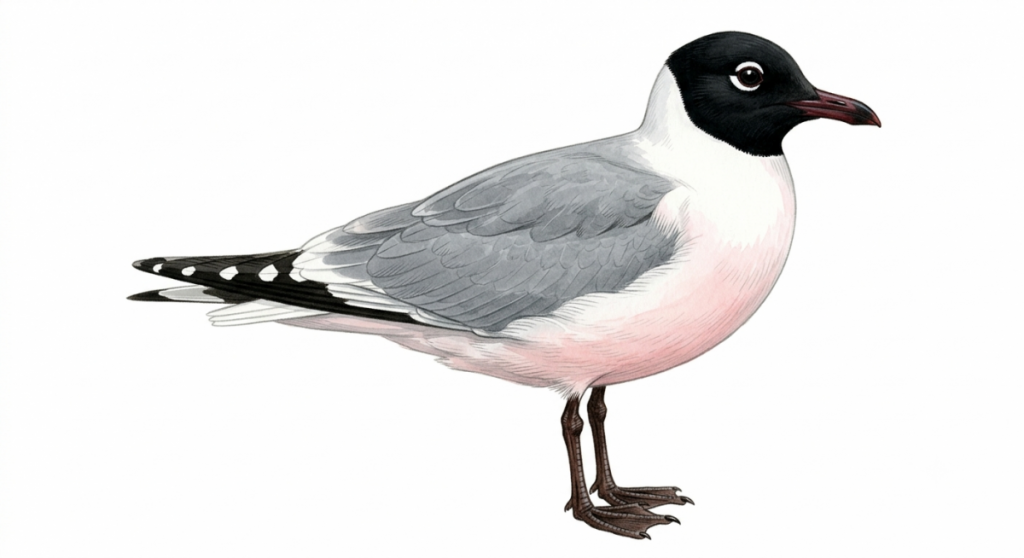
The Franklin's Gull can be identified by its dark grey back and wings, white head and underparts, and a black hood that extends to the throat during the breeding season. Its slender bill and distinctive wing pattern, with a white wing tip and a dark subterminal band, are also key features.
The Franklin's Gull is slightly larger than a Black-headed Gull, but smaller than a Lesser Black-backed Gull, making it a medium-sized gull species.
The male Franklin's Gull has a dark grey back and wings, with a white head and underparts, and a black hood that extends to the throat during the breeding season, which fades to a partial hood or a few dark spots in the non-breeding season.
The female Franklin's Gull is similar to the male, with no significant differences in plumage, although the hood may be less extensive or less intensely coloured.
The Franklin's Gull has a high-pitched, nasal call, often transcribed as a loud, sharp "kee" or "kree" sound, which is frequently used for communication and contact between birds.
Franklin's Gulls are opportunistic feeders, often following ploughs or feeding on small invertebrates, fish, and carrion, and they can be seen flying low over the ground or water, with a swift and agile flight style.
The Franklin's Gull can be confused with the Laughing Gull or the Black-headed Gull, but it can be distinguished by its darker back and wings, more slender bill, and distinctive wing pattern, as well as its smaller size and more agile flight.
Quick Facts
Who's spotted this?
Loading...
Recent community sightings
Loading recent sightings...