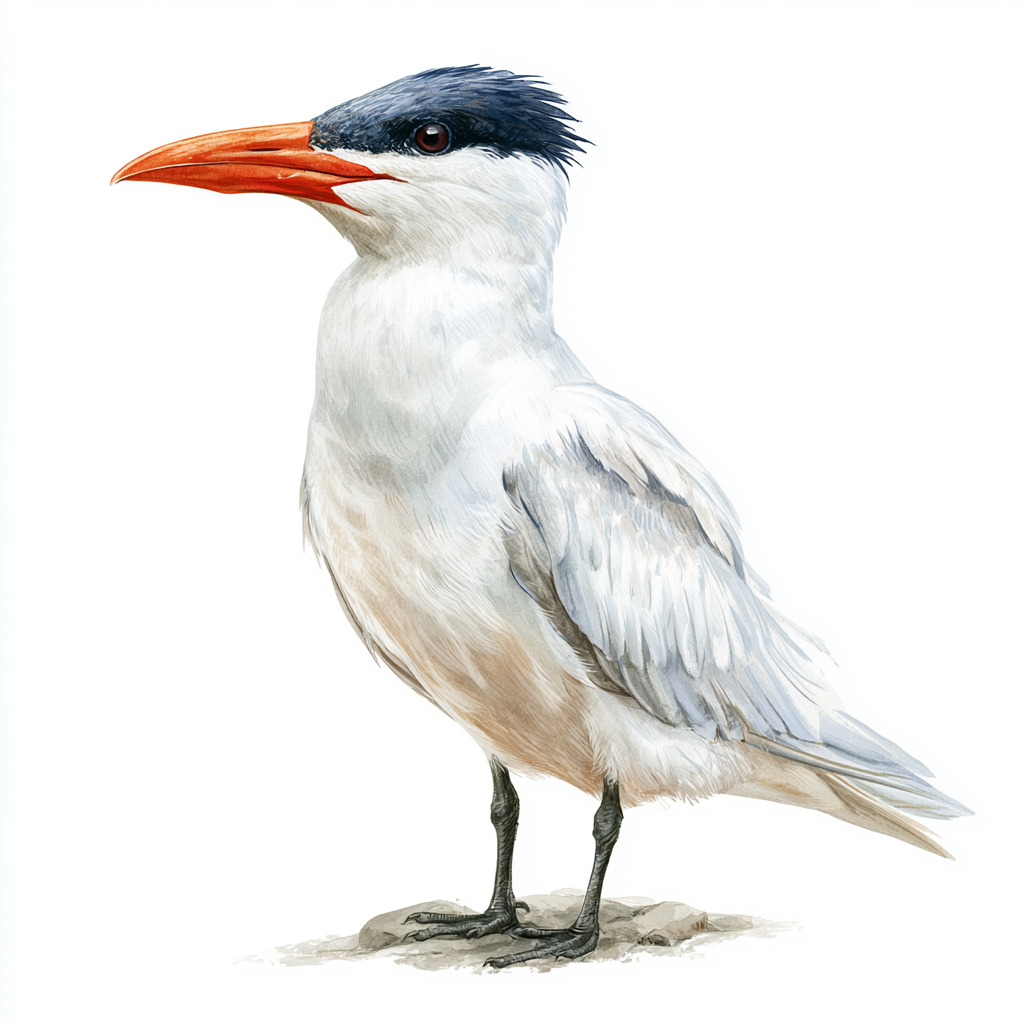
Caspian Tern
Hydroprogne caspia
The Caspian Tern is a rare but regular migrant to Britain, typically seen during the summer months, particularly in coastal areas and around large lakes. It is most often spotted in the eastern and southern regions of the country, although sightings can occur anywhere.
Field Identification Guide
Use these features to identify Caspian Tern in the field.
The Caspian Tern can be identified by its large size, black cap, and distinctive red bill with a black tip, as well as its broad wings and forked tail.
The Caspian Tern is larger than a Herring Gull, making it one of the biggest terns to be seen in Britain.
The male Caspian Tern has a black cap that extends from the forehead to the back of the head, with white cheeks and a pale grey back, while its wings and tail are pale grey with a slight brownish tint, and its underparts are white.
Similar to the male, with no significant differences in plumage, although females may have a slightly less pronounced black cap.
The Caspian Tern's call is a loud, harsh, and grating "krek" or "kraa", often repeated in a series of three to five notes.
Caspian Terns are fish-eaters, diving from the air to catch their prey, and can be seen flying low over the water, scanning for fish, or perched on a rock or beach, surveying their surroundings.
The Caspian Tern can be confused with the Royal Tern and the Lesser Crested Tern, but it can be distinguished by its larger size, broader wings, and the black tip to its red bill, which is not found in the other two species.
Quick Facts
Who's spotted this?
Loading...
Recent community sightings
Loading recent sightings...


