Great Bustard
Otis tarda
The Great Bustard is a rare and occasional visitor to Britain, typically seen in open grasslands and farmland, particularly in the southern regions, with sightings often reported during the spring and autumn migrations. It is a notable species due to its large size and distinctive courtship displays.
Field Identification Guide
Use these features to identify Great Bustard in the field.
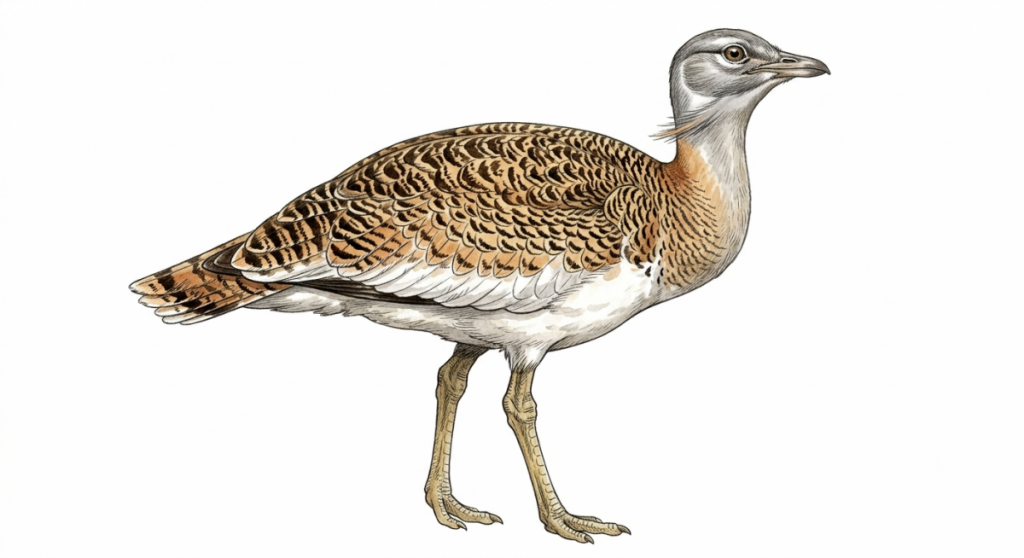
The Great Bustard can be identified by its stout body, long neck, and distinctive white neck stripe, as well as its brownish-grey plumage with a black stripe running across its neck and a white underside. Its large size and broad wings are also distinctive features.
The Great Bustard is larger than a Grey Heron, with males reaching lengths of up to 105 cm, making it one of the largest birds in Britain when it does appear.
The male Great Bustard has a distinctive black stripe across its neck, with a white neck stripe above and a white underside, and its brownish-grey plumage is flecked with black and white, with a distinctive white patch on its lower back.
The female Great Bustard is similar to the male but lacks the distinctive black neck stripe and has a more mottled brownish-grey plumage, making it slightly less conspicuous.
The Great Bustard has a deep, booming call that sounds like a low-pitched "boom" or "poom", often heard during the breeding season or when the bird is alarmed.
The Great Bustard is a ground-dwelling bird that feeds on insects, seeds, and small vertebrates, and is known for its distinctive courtship displays, which involve the male inflating his neck and throat feathers and performing a complex dance.
The Great Bustard can be confused with other large birds such as the Grey Heron or the Little Bustard, but can be distinguished by its larger size, distinctive neck stripe, and broad wings, as well as its booming call.
Quick Facts
Who's spotted this?
Loading...
Recent community sightings
Loading recent sightings...