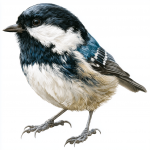
Great Cormorant
Phalacrocorax carbo
The Great Cormorant is a large, dark waterbird commonly seen in Britain, particularly near coastal areas, estuaries, and inland lakes, with sightings possible throughout the year. It is a widespread species, with a notable presence in the UK, especially during the winter months when numbers are boosted by migrants from Europe.
Field Identification Guide
Use these features to identify Great Cormorant in the field.
The Great Cormorant can be identified at a glance by its sleek, black plumage, long neck, and distinctive yellow throat patch, as well as its size and broad, rounded tail. Its wings are long and narrow, with a noticeable kink in the wingtip.
The Great Cormorant is larger than a Grey Heron, with adults reaching lengths of up to 100cm, making it a substantial and imposing bird.
The male Great Cormorant has a glossy, black plumage with a purple or blue sheen in certain lighting conditions, and a white patch on the throat that turns yellow or orange during the breeding season.
The female Great Cormorant is similar to the male, with no significant differences in plumage, although juveniles may have a more mottled, brownish appearance.
The Great Cormorant has a deep, grunting call that sounds like a low "krek" or "gronk", often heard when birds are in close proximity to each other.
Great Cormorants are skilled divers, feeding on fish, crustaceans, and other aquatic prey, and can be seen perched on rocks, trees, or power lines, drying their wings and preening their feathers. They have a direct, purposeful flight style, with slow wingbeats.
The Great Cormorant can be confused with the Shag, but can be distinguished by its larger size, longer tail, and white throat patch, which is more extensive in the Great Cormorant, as well as its more sluggish, less agile flight style.
Quick Facts
Who's spotted this?
Loading...
Recent community sightings
Loading recent sightings...