Razorbill
Alca torda
The Razorbill is a colonial seabird that can be seen in Britain, particularly in the north and west, with notable breeding colonies on rocky coastlines and islands, typically from April to July. It is a relatively rare sight in British waters, but can be spotted on coastal trips and near offshore islands.
Field Identification Guide
Use these features to identify Razorbill in the field.
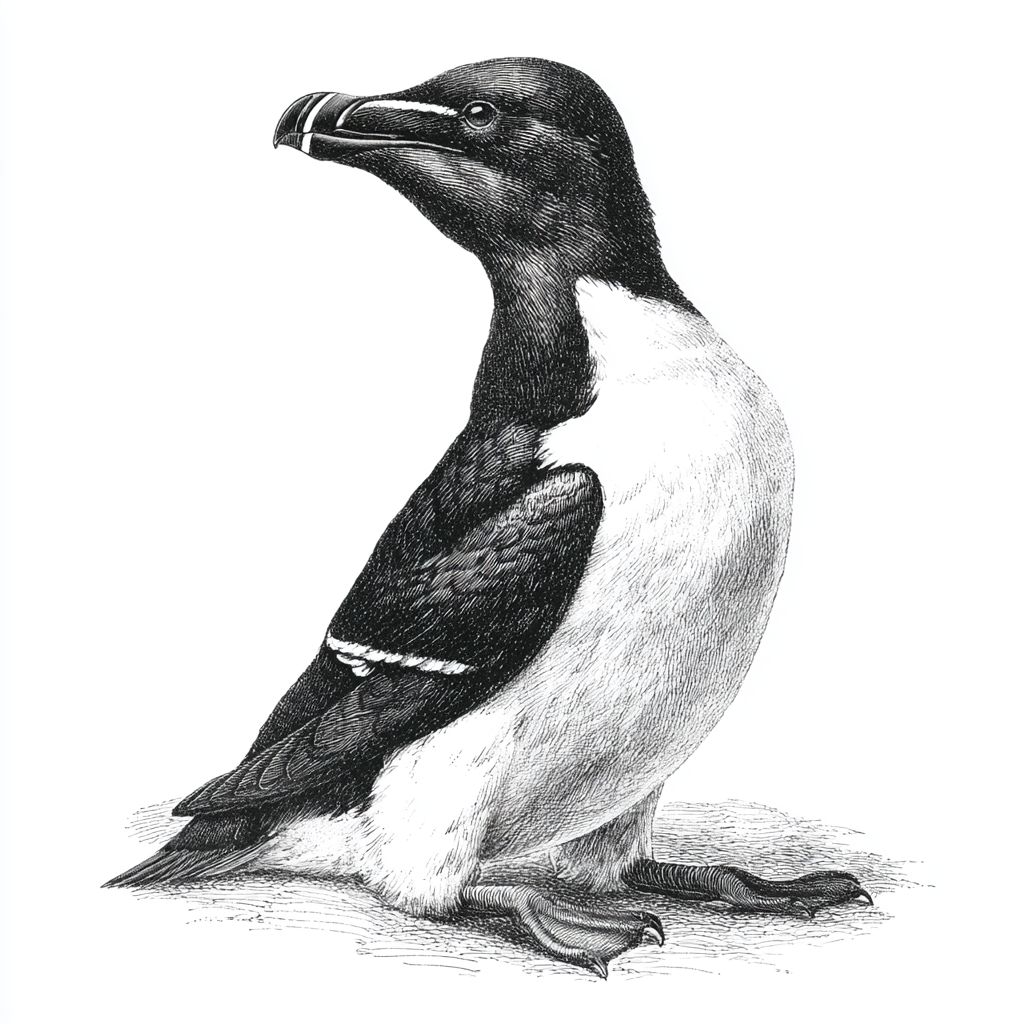
The Razorbill can be identified by its distinctive black and white colouration, with a black back and white belly, as well as its thick, black beak and white stripes above and below its eye. Its streamlined body and short legs also distinguish it from other seabirds.
The Razorbill is slightly larger than a Black Guillemot, but smaller than a Herring Gull, with a length of approximately 30-40 cm.
The male Razorbill has a glossy black back, white belly, and a distinctive white stripe above and below its eye, with a black beak that is thick and deep, and a black head with a white line extending from the beak to the back of the head.
The female Razorbill has similar plumage to the male, with no significant differences in colouration or pattern.
The Razorbill's call is a low, guttural "kraa" or "cronk" sound, often repeated in a series of short, sharp phrases.
Razorbills are skilled divers, feeding on fish, crustaceans, and other marine animals in the coastal waters, and can be seen flying low over the water with rapid wingbeats, or standing upright on rocky ledges and islands.
The Razorbill can be confused with the Guillemot, but can be distinguished by its thicker beak and more pronounced white stripes above and below its eye, as well as its more compact, streamlined body.
Quick Facts
Who's spotted this?
Loading...
Recent community sightings
Loading recent sightings...