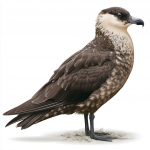
Greater White-fronted Goose
Anser albifrons
The Greater White-fronted Goose is a rare but regular winter visitor to Britain, typically seen from October to March, with the largest numbers found in eastern and southern England. It can be spotted in a variety of wetland habitats, including estuaries, marshes, and farmland.
Field Identification Guide
Use these features to identify Greater White-fronted Goose in the field.
This species is distinguished by its white patch at the base of the bill, salt-and-pepper markings on the breast, and a pinkish-orange bill and legs. The white forehead patch and distinctive breast markings make it readily identifiable at a glance.
The Greater White-fronted Goose is larger than a Greylag Goose, but smaller than a Canada Goose, making it a medium to large-sized waterfowl species.
The male's plumage is a mottled brown and grey, with a white patch on the forehead, and distinctive salt-and-pepper markings on the breast, which give it a speckled appearance.
The female's plumage is similar to the male's, with the same white forehead patch and breast markings, although it may be slightly duller in colour.
The Greater White-fronted Goose has a high-pitched, yelping call, often transcribed as "ka-kak" or "kek-kek", which is typically heard during flight or when the birds are alarmed.
These geese are grazers, feeding on a variety of plants, including grasses, leaves, and aquatic vegetation, and can be seen walking or swimming in search of food, often in large flocks.
The Greater White-fronted Goose can be confused with the Lesser White-fronted Goose, but it is larger and has a more extensive white forehead patch, as well as more pronounced breast markings, which help to distinguish it from its smaller cousin.
Quick Facts
Who's spotted this?
Loading...
Recent community sightings
Loading recent sightings...