Jack Snipe
Lymnocryptes minimus
The Jack Snipe is a rare winter visitor to Britain, typically seen in wetland areas from October to March, with its stocky build and distinctive behaviour making it a sought-after sighting among birdwatchers. It is most often encountered in coastal marshes, estuaries, and inland wetlands, particularly during periods of cold weather.
Field Identification Guide
Use these features to identify Jack Snipe in the field.
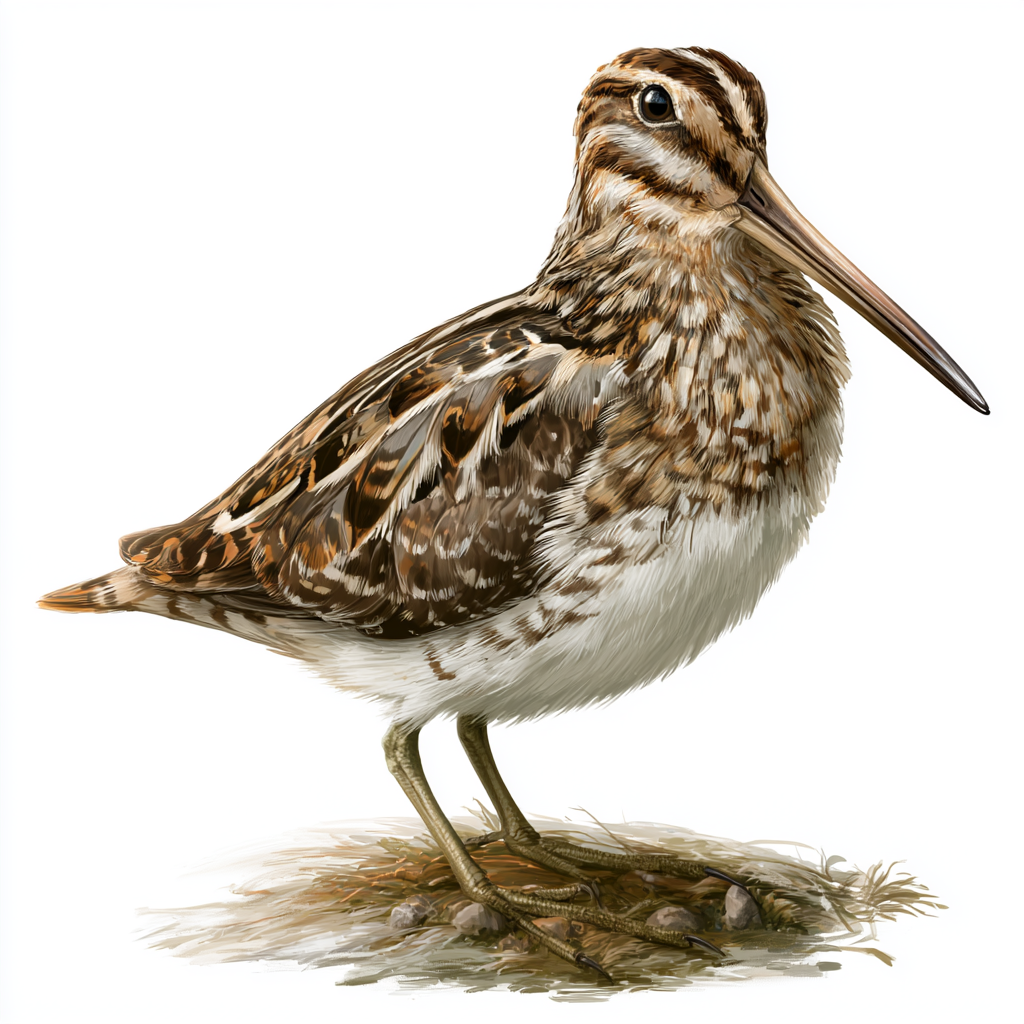
The Jack Snipe can be identified by its small size, distinctive 'bobbing' motion as it feeds, and its continuous up-and-down movement, which is a key distinguishing feature from other snipes and woodcocks.
The Jack Snipe is smaller than a Starling, with a more compact build, making it a diminutive figure among waders.
The male Jack Snipe has a mottled brown and grey plumage, with a distinctive pattern of dark and light stripes on its back, which helps to camouflage it in its wetland habitat, and its plumage remains relatively consistent throughout the year.
The female Jack Snipe is similar to the male in terms of plumage, with no significant seasonal or sexual variations in its colouration or pattern.
The Jack Snipe has a sharp, raspy call, often described as a loud, high-pitched 'chip' or 'tze', which is usually heard when the bird is flushed or in flight.
The Jack Snipe is a secretive and skulking species, with a unique feeding behaviour that involves 'bobbing' up and down as it probes for invertebrates in the mud and vegetation, and it has a rapid, low-level flight when disturbed.
The Jack Snipe can be confused with other snipe species, such as the Common Snipe, but can be distinguished by its smaller size, more compact build, and distinctive 'bobbing' motion, as well as its lack of the distinctive white trailing edges on its wings.
Quick Facts
Who's spotted this?
Loading...
Recent community sightings
Loading recent sightings...