Grey-cheeked Thrush
Catharus minimus
The Grey-cheeked Thrush is a rare migrant to Britain, typically seen during the autumn months, and is notable for its distinctive underwing pattern and northern breeding range. It is an occasional visitor to the UK, with most sightings occurring on the eastern and western coasts.
Field Identification Guide
Use these features to identify Grey-cheeked Thrush in the field.
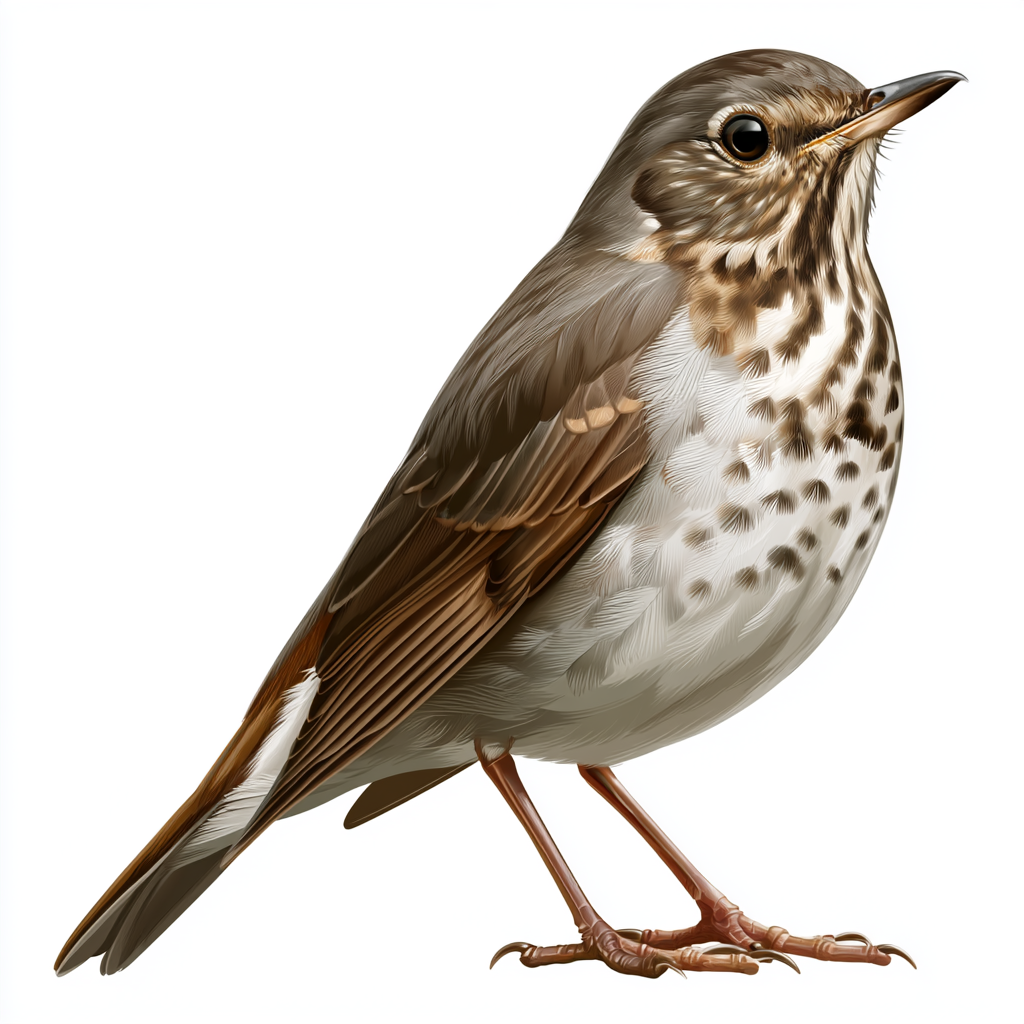
The Grey-cheeked Thrush can be identified by its white-dark-white underwing pattern, grey-cheeked face, and spotted breast, which distinguish it from other thrush species. Its size and shape are also key identification features, with a rounded body and long legs.
The Grey-cheeked Thrush is slightly smaller than a Song Thrush, measuring 15-17 cm in length, and is larger than a Blue Tit.
The male Grey-cheeked Thrush has a brown back, wings, and tail, with a grey cheek patch and a spotted breast, featuring dark brown spots on a pale background, with little seasonal variation.
The female Grey-cheeked Thrush is similar to the male, with the same overall plumage pattern and colouration, although it may be slightly duller.
The Grey-cheeked Thrush has a distinctive song, which is a series of whistled phrases, often described as a descending melody, and a call that sounds like a sharp, metallic "chuck" note.
The Grey-cheeked Thrush is a ground-foraging bird, feeding on insects, fruits, and berries, and has a direct, purposeful flight style, often flying low to the ground.
The Grey-cheeked Thrush can be confused with Bicknell's Thrush, but can be distinguished by its slightly larger size and different song, as well as the Veery, which has a more subdued plumage pattern and a distinctive, monotonous song.
Quick Facts
Who's spotted this?
Loading...
Recent community sightings
Loading recent sightings...