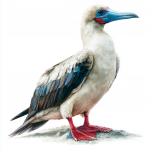
Kelp Gull
Larus dominicanus
The Kelp Gull is a rare visitor to Britain, typically seen on the southern coasts, particularly during the winter months. It is more commonly associated with the Southern Hemisphere, breeding on coasts and islands around South America, Australia, New Zealand, and Southern Africa.
Field Identification Guide
Use these features to identify Kelp Gull in the field.
The Kelp Gull can be identified by its slate-grey back, white head and underparts, and a distinctive black band on its bill, as well as its medium size and broad wings. Its legs and feet are also a notable feature, being greenish-yellow in colour.
The Kelp Gull is slightly larger than a Lesser Black-backed Gull, but smaller than a Great Black-backed Gull, making it a medium-sized gull species.
The male Kelp Gull has a slate-grey back and wings, with a white head, neck, and underparts, and a black tip to its wings, with no significant seasonal variation in its plumage.
The female Kelp Gull is similar to the male, with no notable differences in plumage, making it difficult to distinguish between the sexes based on appearance alone.
The Kelp Gull has a loud, raucous call, often described as a harsh "kraa" or "kaak" sound, which is commonly heard in its breeding colonies.
Kelp Gulls are opportunistic feeders, scavenging for food on beaches, in coastal towns, and around fishing boats, and are known for their bold and aggressive behaviour when competing for food.
The Kelp Gull can be confused with other medium-sized gull species, such as the Lesser Black-backed Gull, but can be distinguished by its slate-grey back, greenish-yellow legs, and distinctive black band on its bill.
Quick Facts
Who's spotted this?
Loading...
Recent community sightings
Loading recent sightings...