Pied Wheatear
Oenanthe pleschanka
The Pied Wheatear is a rare vagrant to Britain, with sightings mostly limited to the eastern and southern coasts during migration periods, typically in spring and autumn. It is a small, insectivorous passerine bird that can be spotted in open, rocky areas or scrublands.
Field Identification Guide
Use these features to identify Pied Wheatear in the field.
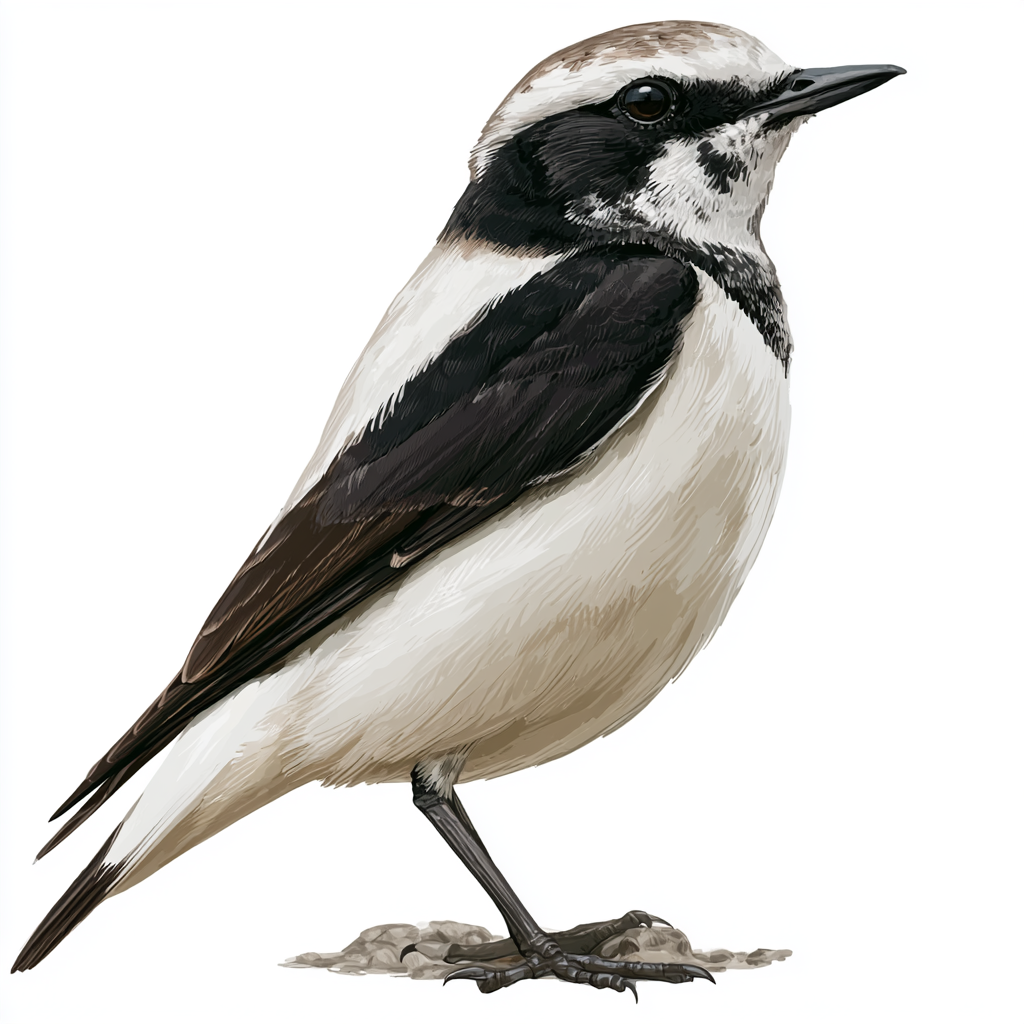
The Pied Wheatear can be identified by its black throat patch, white forehead, and distinctive black and white plumage pattern, with a black back and white rump. Its upright posture and long tail are also notable features.
The Pied Wheatear is smaller than a Starling, measuring around 12-13 cm in length, and larger than a Blue Tit.
The male Pied Wheatear has a black back, white rump, and white forehead, with a distinctive black throat patch and white underparts, although the plumage can appear more subdued during the winter months.
Similar to the male, the female Pied Wheatear has a similar black and white pattern, although the colours may be less intense and the throat patch may be greyish-black rather than pure black.
The Pied Wheatear's call is a sharp, metallic "tek" or "chak" sound, often repeated in a series, while its song is a melodic, whistled phrase.
The Pied Wheatear is an active, ground-foraging bird that feeds on insects and small invertebrates, often perching on low rocks or branches to survey its surroundings, and has a direct, swift flight style.
The Pied Wheatear can be confused with other wheatear species, such as the Northern Wheatear, but can be distinguished by its black throat patch and white forehead, as well as its more subdued colouration and smaller size.
Quick Facts
Who's spotted this?
Loading...
Recent community sightings
Loading recent sightings...